
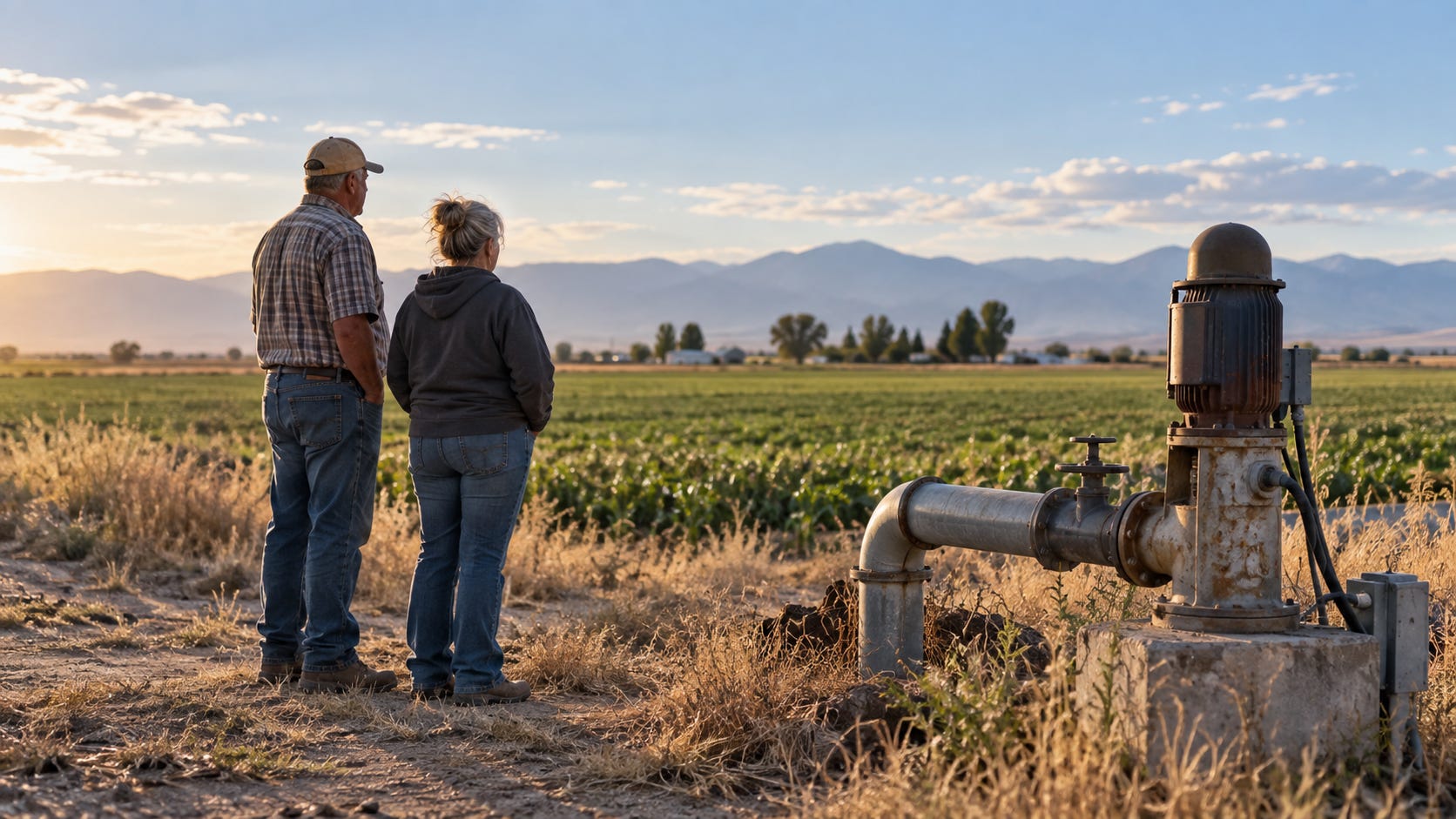
Jerry and Valerie Bingham have water rights dating to 1950. They say their Blackfoot-area farm has been allowed to pump groundwater for only a brief period since Idaho curtailed their irrigation in 2025. This week, the couple took the state to court, arguing that the continued restrictions have deprived them of valuable property and damaged their family business.
The case puts a concrete question before a Bingham County judge: What happens when a farm with decades-old groundwater rights is shut off while some users with later rights keep pumping under state-approved plans? The answer matters to the Binghams now. Their complaint describes crop losses, financial strain and uncertainty over whether they can keep farming.
The order that reached a Blackfoot farm
The Binghams farm about 1,000 acres near Blackfoot and hold six groundwater rights, five dating from 1950 to 1952 and one from 1987, according to accounts of their complaint. In July 2025, the Idaho Department of Water Resources ordered users with groundwater rights dated after October 11, 1900, to stop pumping unless they participated in an approved mitigation plan. The Binghams' rights fall after that cutoff.
The couple says the order and later restrictions have left them unable to irrigate except for a short spell in April 2026. Before 2025, the department generally had not curtailed their five older rights, their complaint says. The new suit, filed September 21 in Bingham County's Seventh District Court, seeks compensation for what the couple alleges is a taking of their water rights. A court has not decided that claim.
Crop losses are at the center of the suit
The family alleges that it lost about $300,000 in potential potato revenue because it could not plant potatoes on its own land and instead rented land to grow them. It also seeks roughly $388,000 for alleged lost wheat revenue from inadequate irrigation, according to an account of the complaint. Those figures are the family's claims, not court findings.
The Binghams say limited water has left fields dry, crops unsuccessful and land unplanted. They have warned the court of possible loan defaults and bankruptcy. Uncertain access to irrigation also complicates decisions made long before a harvest: whether to plant, whether crop insurance will be available, and whether a buyer will offer a potato contract. That is the practical cost behind the legal argument for a farm the family hopes to pass to another generation.
Why other users can still irrigate
Idaho manages groundwater and surface water together in the Eastern Snake River basin. Pumping from the aquifer can affect deliveries to surface-water users with older claims. The department can order groundwater users to reduce or stop withdrawals when it predicts a shortfall, while allowing pumping that is covered by an approved plan to offset its effects.
That distinction is the point of the family's challenge. The Binghams contend that users with groundwater rights younger than theirs have continued to irrigate through mitigation plans while their own pumps remain restricted. Their complaint says they proposed five mitigation approaches that were not accepted. The department's deputy director, Brian Patton, declined to comment on the suit when contacted for a report published this week. The state has not presented its position in a ruling on this new compensation claim.
The court will have to weigh the family's property-rights argument against Idaho's water-management framework. For the Binghams, the immediate question is less abstract: whether they can secure dependable irrigation before another planting season, and whether the farm can absorb another year without it.