
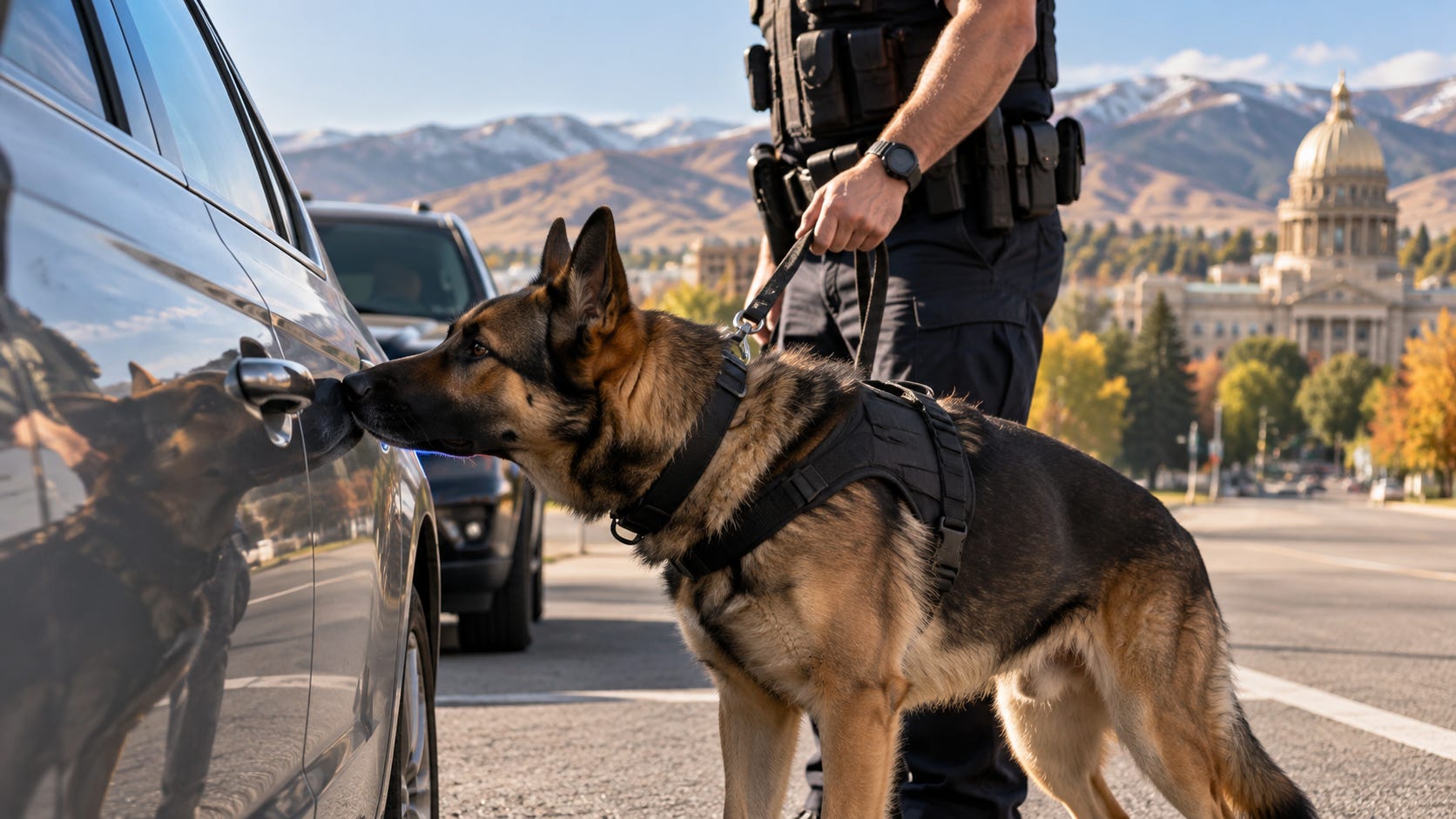
Idaho police dogs can briefly touch a car with their noses during a traffic stop without turning the sniff into a constitutional search, the Idaho Supreme Court ruled Oct. 14. The decision reverses an Ada County judge who had thrown out drug evidence because a K-9 named Edo touched a car door handle for less than a second.
The ruling in State v. Pendleton revives a drug possession case from a 2021 stop. It also narrows what counts as a trespass under a 2023 precedent that Idaho judges use to decide when a police dog's contact with a vehicle turns a sniff into a search.
Ten seconds at an expired-registration stop
Police stopped Shawna Rae Pendleton on Oct. 29, 2021, because her vehicle registration had expired. Officer Tad Miller and Edo, his drug-detection dog, were called in to run a free-air sniff around her car.
According to the court's account, Miller clipped a six-foot leash to Edo's collar, had him sit a few feet in front of the car and then sent him to work. Edo hurried to the driver's door, huffing along the way, nosed the outside handle and jerked his head toward his handler. Miller calls that head snap Edo's final alert. The dog repeated the routine at the passenger door, where his nose probably touched that handle too. The entire sniff lasted roughly ten seconds.
Officers searched the car without a warrant. Between the car and a search of Pendleton after her arrest, they turned up methamphetamine, marijuana, the anxiety drug alprazolam and drug paraphernalia. She was charged with three counts of possessing a controlled substance and one count of possessing paraphernalia.
Pendleton argued that Edo's nose was a trespass on her car, which would make the sniff a search that needed a warrant. District Judge Jason D. Scott agreed. He relied on State v. Dorff, the 2023 case in which a divided Supreme Court held that police conducted a search when their drug dog, Nero, planted his front paws on a driver's door and window during a 2019 stop. Scott also doubted anyone could pinpoint the moment Edo traced the odor before touching the handle, since the touch came only a few seconds into the sniff. The Idaho Court of Appeals reversed him in August 2025, and the Supreme Court agreed to review the case.
Where the justices drew the line
Justice G. Richard Bevan wrote for the majority. Chief Justice Robyn M. Brody signed on, as did Justice Colleen D. Zahn. Under Dorff, a dog's contact with a car counts as a trespass, and can turn a sniff into a search, only when it rises to intermeddling. Bevan wrote that intermeddling takes more than a minimal touch. The contact has to meaningfully interfere with the owner's right to possess and use the property.
Edo's contact did not meet that bar, the court found. The touch was over in under a second, it ended when he pulled back to alert, and he never got inside the car. The opinion offered a comparison: someone who rests a hand on a stranger's car while squeezing through a crowded parking lot touches it on purpose, yet few people would call that an intrusion. It also pointed out that the Restatement of Torts, the legal reference Dorff borrowed its definition from, illustrates intermeddling with someone beating another person's horse or dog, not petting one.
Because the court found no trespass, it did not decide the state's fallback argument that Edo had already alerted before his nose reached the handle.
For K-9 handlers and patrol officers, the ruling means a fleeting bump during an otherwise lawful sniff does not by itself turn the sniff into a search. The ruling leaves Dorff on the books. Under that precedent, a dog that props its paws on a door or window, sits on a hood or pushes into a car's interior can still turn a sniff into a search.
Two justices want a simpler test
All five justices agreed on the outcome, but they split 3-2 over the reasoning. Justice Gregory W. Moeller, who dissented in Dorff, concurred only in the result, and Justice Cynthia K.C. Meyer joined him. Moeller wrote that the court keeps leaning on tort law and leaves trial judges with the job of "divining a drug dog's intentions." Dogs use their whole bodies to follow a scent, he wrote, and the constitutional question should be "what the dog did," not what it meant to do.
Moeller acknowledged that police must train and control their dogs, but he warned that courts should not impose unrealistic rules that fight a dog's nature and leave a police tool ineffective. He pointed to the Iowa Supreme Court, which ruled in 2024 that a brief touch of a car's exterior does not matter so long as the dog stays out of the vehicle. The Iowa court nicknamed its holding "ruff justice," Moeller noted. After arguing that a dog cannot form the intent to intermeddle, he added a footnote: as for cats, the jury may still be out.
Brody, joined by Zahn, answered in her own concurrence. She wrote that trespass principles belong in Fourth Amendment analysis and that abandoning Dorff would cut Idaho's search rulings off from the amendment's original meaning.
Edo's reliability is still an open question
The decision does not end the prosecution, and it is not the first time the case has reached the state's highest court. In 2023, the justices upheld an order requiring prosecutors to hand over records of Edo's past performance, including videos and reports. Scott had questioned whether the dog was truly tracking an odor or simply doing what earns him a reward, and a defense canine expert voiced the same doubts. Edo has since retired. He left police work in May 2023 after seven years on the job.
Pendleton also argued that Edo was too unreliable to justify a search, while prosecutors have maintained he was a dependable drug-detection dog. The district court set that challenge aside, planning to take it up only if it found no trespass. Now that the Supreme Court has found none, the reliability fight is back in play. With the case remanded for further proceedings, the question of whether one police dog's alerts can be trusted now returns to the Ada County courtroom where the case began.