
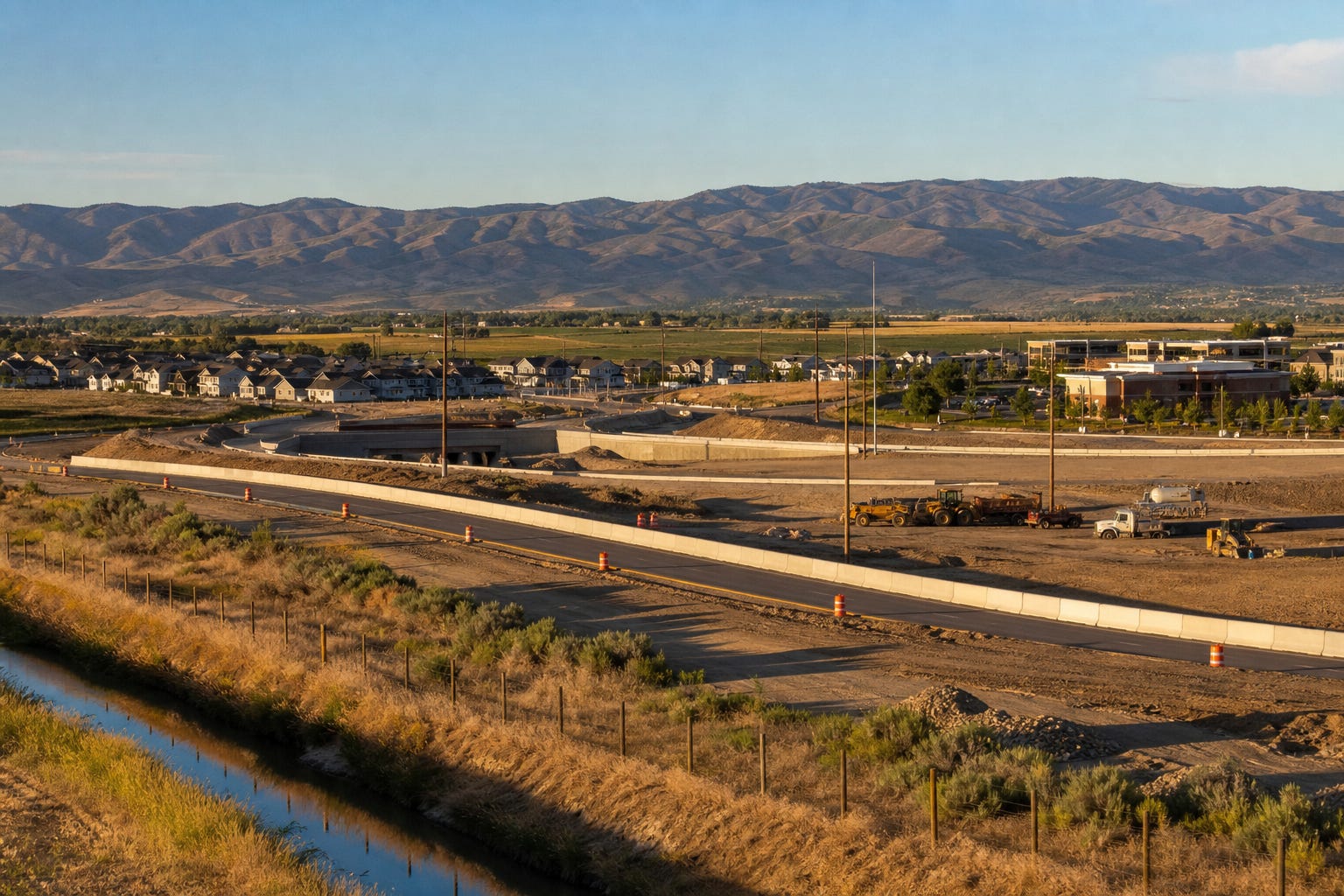
Northwest Meridian's next growth test has reached City Hall. The Planning and Zoning Commission has recommended approval for two early projects near the future Idaho 16 and Ustick Road interchange, sending a 4-acre commercial plan and a 36-acre housing-and-office subdivision toward a July City Council review.
The corner matters because it sits near one of the few planned access points for the new Idaho 16 corridor between Chinden Boulevard and Interstate 84. Transportation officials expect the full corridor to open in 2027, and local planning material treats the surrounding Fields area as one of Meridian's last major growth zones. In plain terms, the road is coming. Now the question is what private development, city rules and taxpayer-backed infrastructure will let grow around it.
The first projects are small, but the location is not
The smaller proposal comes from Boise-based Hawkins Cos., which wants the parcel at 5900 W. Ustick Road, about four acres, brought inside city limits for a project called McUstick. The plan points toward a compact commercial corner, including a gas station and convenience store, a coffee kiosk and possible service businesses such as an oil-change shop, car wash, bank or similar neighborhood-serving use.
Next to it, the Durango subdivision would add 127 detached homes and six office structures on about 36 acres north and east of the commercial site. Application materials described the office portion as a place for lower-impact employers, including professional offices and technology or resource-center uses. Mark Hess of Nampa-based J&J Hess LLC is tied to that development.
Those numbers are modest compared with the scale of Meridian's growth. The important part is timing. These projects are among the first proposals trying to claim ground around the future Ustick interchange, before the daily traffic pattern has fully arrived and before City Hall has settled what that gateway should look like.
The road is changing the market
The Idaho Transportation Department has described the State Highway 16 extension as the Treasure Valley's first new freeway in more than four decades. The limited-access corridor is planned to link Interstate 84 with State Highway 44, with ramps only at five points: I-84, Franklin, Ustick, the U.S. 20/26 corridor and SH-44.
That is why a 4-acre commercial request carries more weight than its acreage suggests. ITD says the corridor is meant to improve mobility across Ada, Canyon and Gem counties, and the state accelerated the final phase with transportation bonding dollars aimed at congestion and growth. The new U.S. 20/26 interchange is being built so Idaho 16 traffic can move over Chinden Boulevard without stopping, with dedicated ramps and turn lanes.
For drivers, that means another north-south route in a valley that badly needs one. For landowners and businesses, it means the value of nearby corners changes fast. For families, it means the tradeoffs arrive just as quickly: more services close to home, more jobs near new neighborhoods, and more pressure on roads that already shape daily life.
City Hall still has the final call
Meridian's Fields Subarea Plan describes a northwest growth area framed by Ustick to the south, McDermott and SH-16 to the east, Chinden to the north and Can-Ada to the west. The plan calls for more employment, high-quality neighborhoods, parks, pathways and schools, with interchange and regional mixed-use areas near Ustick and Chinden.
That is the local-control issue in front of the City Council. Planning staff raised concerns that auto-oriented businesses near the interchange could conflict with the city's long-term vision for the area. The commission still gave McUstick a unanimous recommendation on May 28 and also advanced the nearby Durango plan.
The cleanest answer is not to pretend growth can be stopped after the freeway has already been funded and built. It is to make growth pay attention to the people who will live with it. If Meridian wants the new interchange to serve families, workers and small businesses instead of becoming another traffic chute, the details need to be nailed down before the cars arrive. July's council review is the next test.