
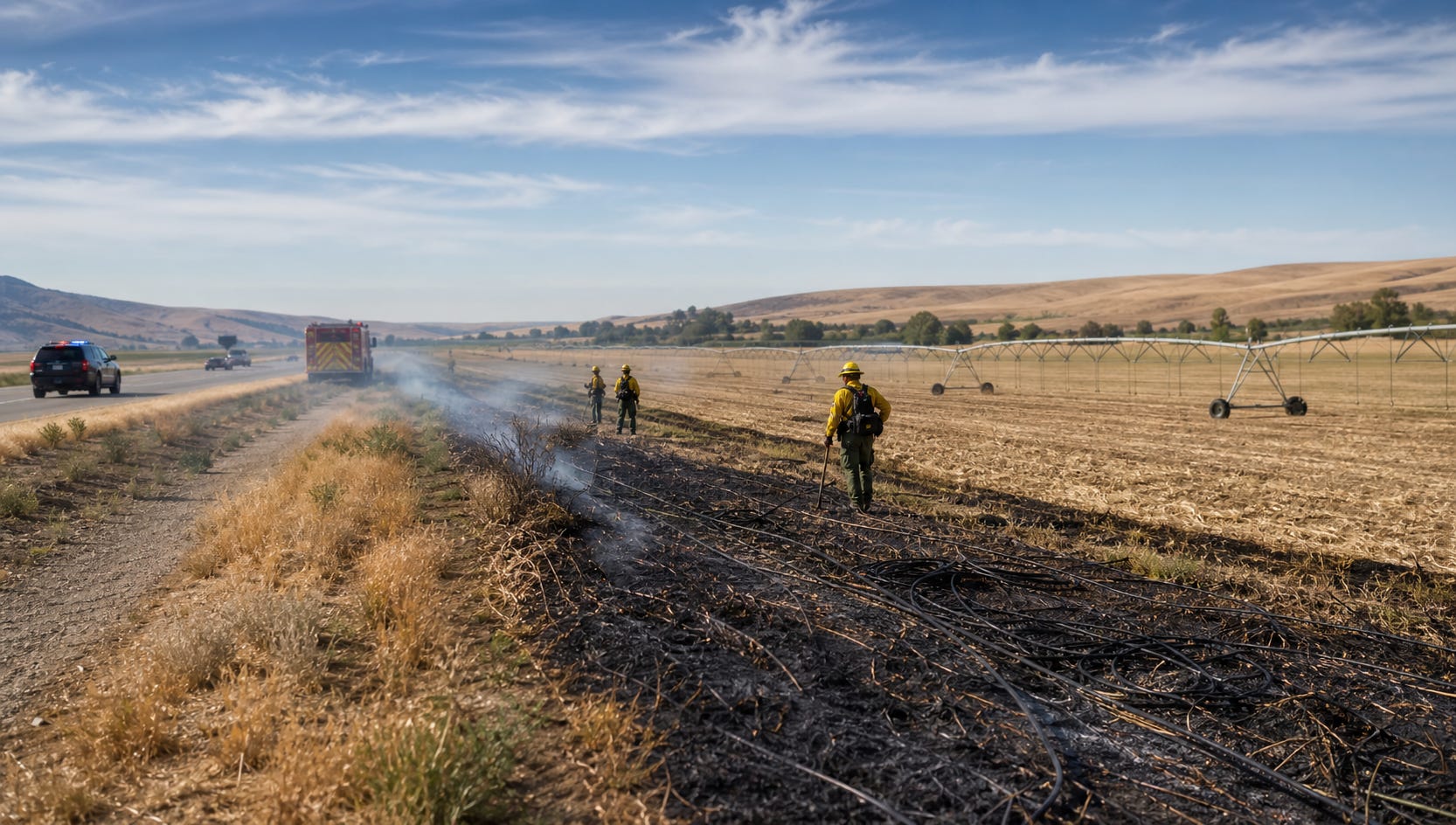
State fire officials say someone deliberately set the Payette County wildfire that broke out beside westbound Interstate 84 near milepost 15, turning what first looked like a windy farm-field fire into a public safety case with unanswered questions. The fire stayed under 100 acres and no homes were damaged, but the lesson for rural Idaho is hard to miss: in dry wind, one roadside ignition can put firefighters, deputies, motorists and families into a fast-moving risk no local community should have to absorb.
Firefighters stopped a bad day from getting worse
The wildfire was reported in a farm field along the westbound side of I-84 in rural Payette County. The Idaho State Fire Marshal's Office said Sand Hollow Fire District crews were dispatched at about 4:30 p.m. as a sudden windstorm moved through the area. Early callers reported flames coming from discarded drip tape, an irrigation material used in farming.
Once the wind hit, the fire moved into dry vegetation. A Sand Hollow bulldozer arrived quickly and helped separate the burning material while crews from Sand Hollow and neighboring departments worked the fire line. The response kept the burn area below 100 acres, according to state fire officials.
That matters beyond one field. Payette County sits in the kind of working rural landscape where roads, farms, homes and open ground can all share the same wind. A fire that starts beside the interstate can become a property problem, a traffic problem and a family safety problem in minutes. The fact that no homes were damaged is a credit to the local response, not proof that the risk was small.
The investigation now runs through passing traffic
State Fire Marshal Knute Sandahl determined the fire was intentionally set, and investigators are asking for help from people who were on westbound I-84 near milepost 15 shortly before the fire began. They are looking for details about vehicles, people or unusual activity in the area.
This is where public safety gets local and practical. A driver who saw something odd may not know it mattered at the time. A farmer, a commuter or a trucker may have one detail that helps investigators narrow the timeline. State officials are asking those people to contact the arson hotline rather than assume someone else already called.
The case also shows why roadside fires deserve more attention than a short burst of smoke on the evening commute. Firefighters can contain a blaze, but accountability depends on witnesses, timely tips and residents who treat rural arson as a real threat to property and public order.
Rural Idaho pays when fire is treated casually
This fire did not become a disaster. That is the good news. The warning is that it could have, because dry vegetation, farm material and strong wind do not leave much margin for error. Idaho communities rely on local fire districts to move fast, often across long stretches of road and open land, when conditions turn.
For taxpayers, that response is not abstract. Every avoidable fire pulls people, equipment and public money toward a preventable emergency. For families along rural roads, it means one reckless act can turn an ordinary afternoon into evacuation worries, highway disruption and a call for help from volunteers and neighboring departments.
The state is now asking the public to help finish what firefighters started. They kept the flames from reaching homes. Investigators still need to know who lit the fire, why it started where it did and whether anyone on the interstate saw the missing piece.