
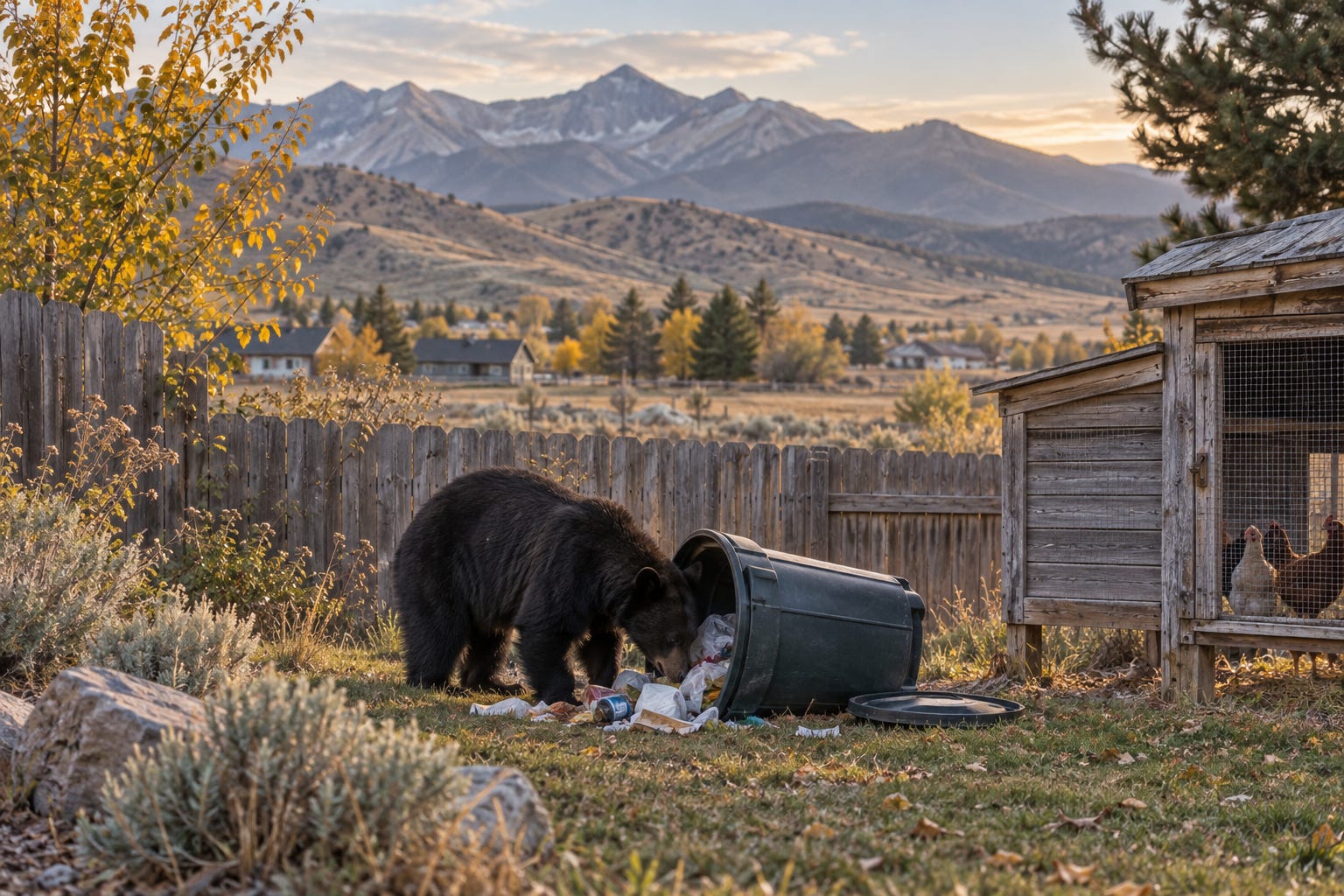
Around 3:30 in the morning on Oct. 2, a young black bear shoved its way into the back doorway of a home in the Sunset Heights subdivision near Salmon. Brian Heidemann met it there. His wife, Kimberlie, said he tackled the bear into the backyard and wrestled with it on the ground as the family dog joined the fight.
Both of them were hurt. A helicopter carried one of them to the hospital in Idaho Falls, and Kimberlie Heidemann said her husband suffered life-threatening cuts and spent two days in the hospital before coming home to recover. She described the night as "something out of a horror movie."
The Salmon attack came in what one Fish and Game manager calls an abnormal year for Idaho's black bears. Frost damage and dry conditions left hillsides short of berries just as bears were bulking up for winter, and from the Treasure Valley to Teton Valley, hungry bears went looking for calories in backyards, garages, trash cans and chicken coops.
Now the bears are heading for their dens, and Fish and Game wants homeowners to clear out the garbage, pet food and other easy meals before the animals come out hungry next spring.
A bear at the back door
Lemhi County sheriff's deputies and Fish and Game officers were on the case by about 4:30 a.m., and the agency called in its Wildlife Human Attack Response Team. The bears were gone when officials reached the home around 6 a.m. A houndsman followed their trail. The sow was found dead; a neighbor had shot her soon after the attack. The next morning, officers trapped her two young bears and put them down. Idaho law lets people kill wildlife to protect themselves, others, pets or livestock from imminent harm, the agency noted.
The trouble had been building. Kimberlie Heidemann said a bear had been killing the family's chickens in the week before the attack, and that Fish and Game told them not to confront the animals because it hoped to relocate them.
Fish and Game says a neighbor first reported a sow with cubs eating chickens there on Oct. 1. The chicken owners had not called the agency, and without permission to enter their land, officers set three traps near the coop on the neighbor's side of the line. Investigators later found the bears had also spent days eating from a large heap of loose household trash outside the home, which the homeowners have since cleaned up.
Regional wildlife manager Dennis Newman warned that even a barbecue or smoker can draw bears "if left uncleaned and outside."
From Boise to Teton Valley
Salmon was not an isolated case. In Swan Valley on the night of July 12, a black bear clawed through a window screen while the homeowners slept, went through the kitchen and polished off a pumpkin pie sitting on the table. It came back the next night for the trash, and the agency trapped and killed it. In Fremont County, another bear spent roughly a week raiding occupied houses, garages and cabins around Robinson Creek, Potpourri and Shadow Ridge before it was euthanized.
On Aug. 31, Pocatello had its first bear incident inside city limits since 2018, when biologists caught a young bear climbing a backyard fence and eating berries. In Boise, Fish and Game handled three bear calls in one September week, starting with a cub in Harris Ranch on Sept. 2, then two more on Sept. 9 near Warm Springs Avenue and Parkcenter Boulevard. One of those bears was bound for a rehabilitation center; the other was euthanized.
The biggest numbers come from the Upper Snake Region. Eric Freeman, who manages human-wildlife conflict there for Fish and Game, told Teton County commissioners this month that the agency has put down seven black bears this year in Teton Valley alone, plus three elsewhere in eastern Idaho, and moved five others. By his count, the number of bears put down this year already matches the previous five years combined. The region has taken about 100 bear calls, roughly five times normal. When Brad Wolfe, the commission chair, asked if conflicts had doubled or even tripled, Freeman said, "Far in excess of double and triple."
Southeast Idaho is on pace for a record year, with several bear calls a day. The bears have reached the highway, too. On Oct. 7, Bart Churches, 55, a Jackson, Wyoming, detention officer, hit a black bear with his motorcycle on Pine Creek Pass and was airlifted to Idaho Falls. His family said Oct. 11 that he was making steady progress, and a hospital spokesperson said the next day that he remained in critical condition.
Why the bears came down
Fish and Game points first to food. In southeast Idaho, wildlife manager Zach Lockyer blamed an early spring frost that knocked out much of the berry crop. In Teton Valley, Freeman described 20 unusually warm March days that got plants growing early, then a hard freeze in mid-June that likely killed the fruit blossoms, all after a mild winter with little snow. The result, he said, was "very few berries" on the hills.
That shortage hit at the worst time. In the fall, a black bear can take in 20,000 calories or more daily as it fattens up for winter. Lockyer said hungry bears are "venturing further into odd places," and a bear that finds trash once will keep coming back.
Freeman named a second cause: growth. More houses and more people keep moving into bear range in Teton Valley, he said, and more conflict will likely follow. "All of Teton County is bear country," he said. Fish and Game says nearly all of Idaho can be bear habitat.
Local answers instead of new mandates
Freeman told commissioners most conflicts start with something people left outside, and early calls tend to end better. Some neighborhoods have held off on calling for fear the bear will be killed, he said, but waiting can push a bear "past the point of no return." Once a bear breaks into a home, it is "maybe like a one-strike deal."
Teton County commissioners have not reached for new rules. One resident, whose family goes back generations in the valley, said a bear had killed one of their turkeys, called this year an anomaly and asked the board not to impose lasting requirements. Wolfe said the meeting was not about making orders but about helping people "know what they can do" on their own.
Much of the answer sits with homeowners. Freeman pointed to Island Park, where bear-resistant cans sit at nearly every home, as a place with fewer conflicts, though he called the comparison anecdotal. In Teton Valley, he said, the cans run about $12 more a month through the local trash service. Fish and Game also weighed a feeding program for bears and decided "the risks outweigh the rewards."
What families can do before spring
Idaho's black bears usually den between mid-October and the end of November and come out between mid-April and May. Over the winter, males typically lose 15 to 30 percent of their body weight, and mothers with cubs can lose up to 40 percent. Once out, they try to eat 15,000 to 20,000 calories daily. That means two kinds of bears to watch for next spring: ones that went into their dens underweight, and ones that already know where the easy food is.
Fish and Game's checklist is short. Keep trash in a bear-resistant can, or lock it in a garage or shed until the morning it gets picked up. Bring pet food and livestock feed inside. Clean up fallen fruit. Scrub grills and smokers. Take bird feeders down from April until mid-November. On parts of the Caribou-Targhee National Forest, a Forest Service order already requires food and trash to be secured from March 1 through Dec. 1.
The agency's rule of thumb is that a fed bear is a dead bear. Freeman called this year's trouble "a west-wide phenomenon" and said there is "certainly a possibility" it becomes a new normal. Whether Idaho sees a repeat next spring may come down to what homeowners leave in their own backyards.