
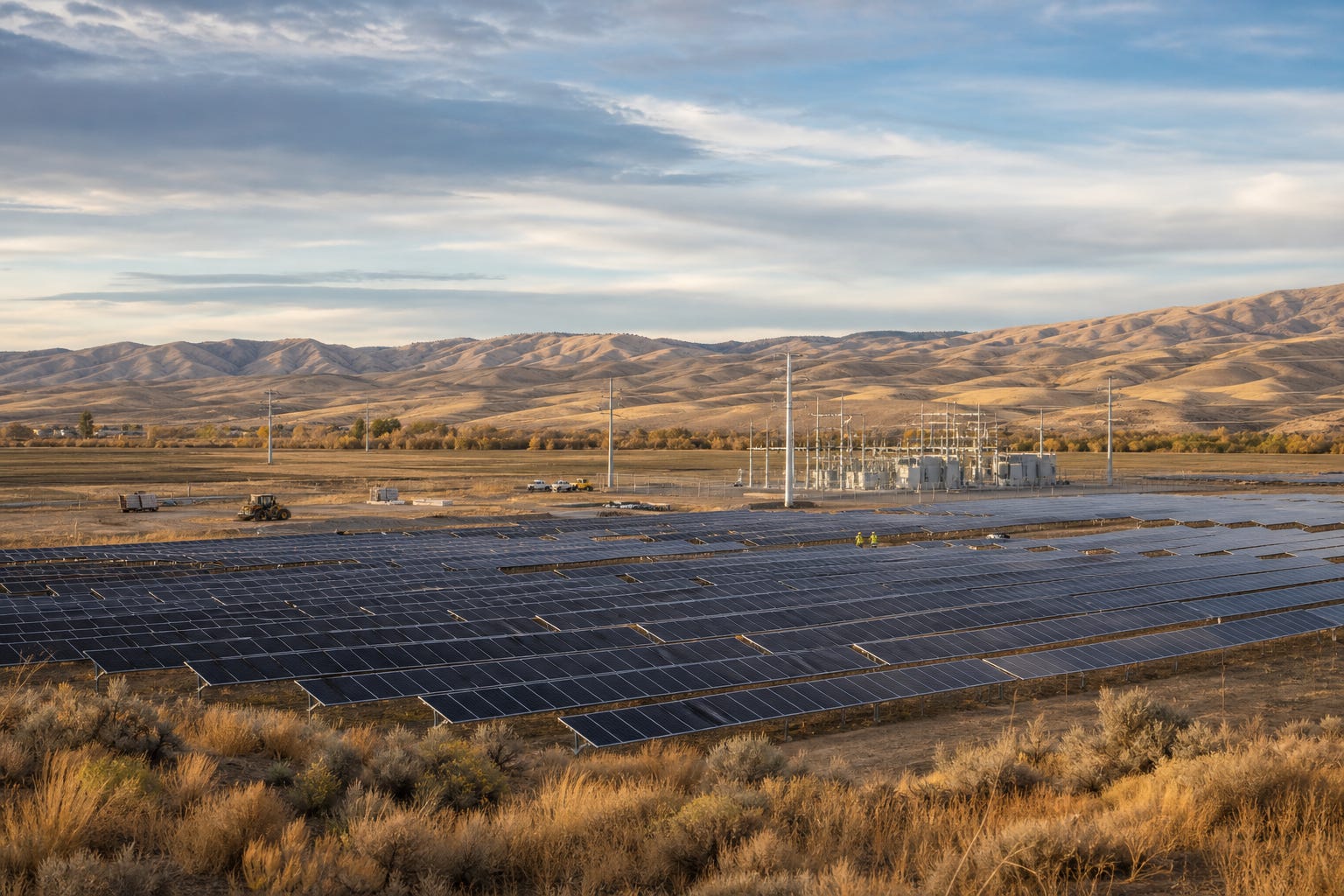
Ada County's newest power project arrived with a second, larger construction start right behind it. rPlus Energies said Tuesday that Pleasant Valley Solar 2, a 125-megawatt facility, is now operating, while work has begun on the 400-megawatt Blacks Creek Energy Center. Together, the projects represent more than $750 million in investment and put a concrete number on the electricity buildout accompanying Treasure Valley growth.
Pleasant Valley 2 is now feeding Idaho's grid
Pleasant Valley Solar 2 sends its output to Idaho Power's grid. The developer says the project, combined with the completed 200-megawatt Pleasant Valley Solar 1 facility, gives the first two phases of the Pleasant Valley complex 325 megawatts of capacity.
The newer phase was built under a long-term power arrangement involving Idaho Power and Meta. The companies structured the project to add generation to the utility's system while supporting Meta's plan to match the electricity used by its Kuna data center with new renewable energy.
Meta says the Kuna campus represents an investment of more than $800 million. Its own project summary lists about 1,000 skilled trade workers on site at peak construction and roughly 100 operational jobs once the data center is complete. That makes the 125-megawatt milestone part of a much larger local infrastructure and jobs story, not a stand-alone ribbon cutting.
The next Ada County project is 400 megawatts
Construction is now underway on the Blacks Creek Energy Center, a 400-megawatt project in Ada County. Industry reporting says rPlus secured more than $650 million in debt and tax-equity financing commitments for the project in March.
Counting facilities already operating, being built or under contract, rPlus says its Idaho portfolio now exceeds 1 gigawatt of solar and storage capacity. That pipeline is arriving as Idaho Power faces rising demand from population growth and large commercial customers.
Idaho Power President and CEO Lisa Grow said in the developer's announcement that the utility needs a balanced mix of resources to serve growing communities. She tied Pleasant Valley Solar 2 and Blacks Creek to the company's goal of keeping electricity reliable and affordable. The utility's own framing makes the practical standard clear: new capacity has to support growth without losing sight of service and cost.
Jobs, scholarships and tax revenue follow the projects
rPlus says the two projects will produce hundreds of construction jobs and permanent on-site positions. When Pleasant Valley Solar 2 broke ground, the developer estimated that phase alone would require about 200 construction workers and disclosed a $179 million construction debt facility.
The projects also fall under a state levy equal to 3.5 percent of a solar facility's gross earnings, with proceeds flowing to Idaho and local taxing bodies. That gives counties and other local governments a continuing financial stake after construction crews leave.
Students at two Treasure Valley colleges, the College of Western Idaho and Boise State University, received $375,000 in workforce-development scholarships from Pleasant Valley Solar 2 partners. The connection between major construction, skilled work and local training is especially relevant in a region trying to add employers without importing every worker it needs.
Kuna's data center makes the local stakes larger
Meta's Kuna investment already reaches beyond electricity. The company says it spent $70 million to build a water and wastewater treatment system that was transferred to the City of Kuna. That system now forms part of the infrastructure serving the city's recently annexed eastern area. A related reuse system is intended to turn treated campus wastewater into irrigation water for non-edible crops.
Those details show how one large employer can reshape several parts of a growing city at once: power supply, water service, skilled work, land development and the local tax base. They also explain why energy capacity is becoming a core growth issue for Ada County rather than a narrow debate about one type of generation.
Idaho's latest solar milestone is therefore less about an ideological energy contest than about whether a fast-growing region can build what new employers require. Ada County now has 125 more megawatts online, a 400-megawatt project underway, new work for skilled trades and new tax revenue on the calendar. The next accountability test is straightforward: finish the build, keep power reliable and affordable, and make sure growth strengthens the communities carrying it.