
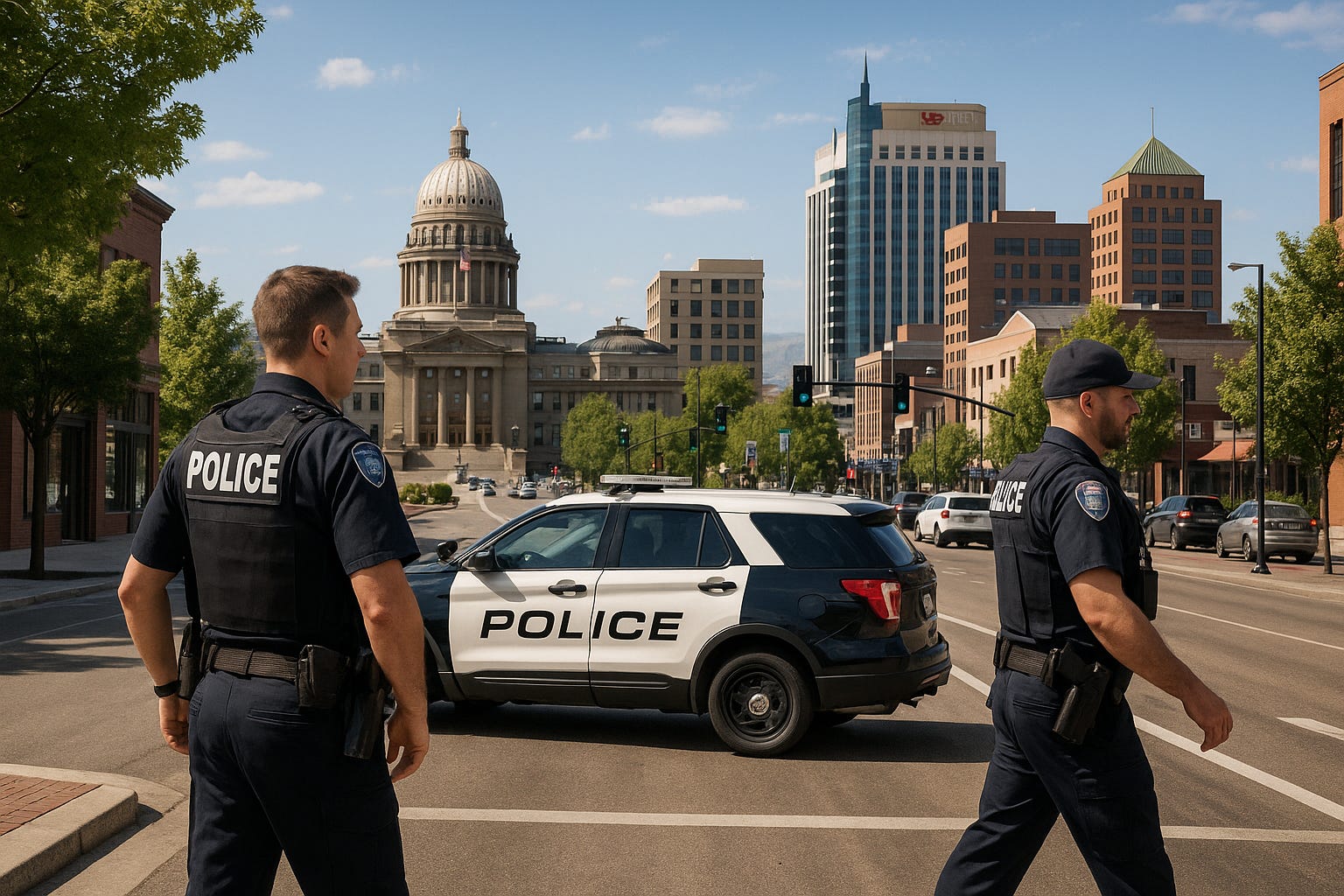
Boise's latest public safety story is not a new crisis. It is the absence of one.
According to Idaho Statesman reporting republished by Police1, the Boise Police Department has gone nearly 18 months without a police shooting. The last one listed by city records came in November 2024. That pause follows a difficult stretch: six police shootings in 2023, four of them fatal, and six more in 2024, including three fatal cases.
For a fast-growing capital city, that is more than a statistic for City Hall. It is a quality-of-life question for families, business owners, officers and neighborhoods that expect public order without needless tragedy. Boise is adding people, traffic, calls for service and political pressure. The public safety system has to absorb that growth without making every hard moment more dangerous.
Police Chief Chris Dennison has pointed to a practical mix: more scenario-based training, more distance and time on dangerous calls, and more tools short of a firearm. The Police1 account, drawing from Statesman reporting, says the department's less-lethal weapon use rose 57 percent in 2025, from 30 uses the year before to 47, while instances of officers pointing guns fell 18 percent, from 116 to 95. Pepper ball use also climbed from two deployments in 2024 to 18 in 2025.
Those numbers do not prove a single cause. Boise's own Office of Police Accountability has cautioned against reading too much into one year. But the pattern is worth attention because it points toward a public safety approach that is both firm and restrained. Officers still need authority, backup and tools. Residents also have an interest in tactics that create space before a split-second decision becomes permanent.
City records show the department has been building around that idea. Boise Police's 2025 Report to the Community says the city opened the new White Water Station on State Street, purchased a mobile command vehicle and rescue vehicle, added a third Behavioral Health Response Team and published a strategic plan. For 2026, the same report lists six additional detective positions, a shelter and support services liaison, a facilities master plan, more less-lethal resources and additional employee wellness training.
That is the unglamorous side of public safety, which is also the side taxpayers should watch most closely. Better facilities, trained detectives, crisis response capacity and less-lethal options do not make dramatic headlines by themselves. They matter because they give a growing city more ways to solve trouble before it becomes a fatal confrontation.
The accountability piece matters too. Boise's critical incident records explain that serious officer use-of-force cases are investigated by the Ada County Critical Incident Task Force, with an outside agency leading the criminal review and prosecutors determining whether laws were broken. The city's list of 2024 critical incidents includes officer-involved shootings on November 13 and November 10, among others. A February 2026 Office of Police Accountability report on a March 2024 hospital incident shows how detailed those reviews can become after a high-risk call.
The best reading of Boise's 18-month pause is not that the problem is solved. It is that local choices may be buying the city something valuable: time, options and a chance to keep order with fewer irreversible outcomes. Idaho communities are rightly skeptical of slogans from either side of national policing debates. Boise's current lesson is more concrete. Train officers, equip them well, review serious force openly, and measure whether families are safer at the end of it.
If the trend holds, Boise will have done something useful for the rest of Idaho. It will have shown that support for law enforcement and restraint in dangerous moments are not opposites. In a growing city, they may be the same public safety strategy.