
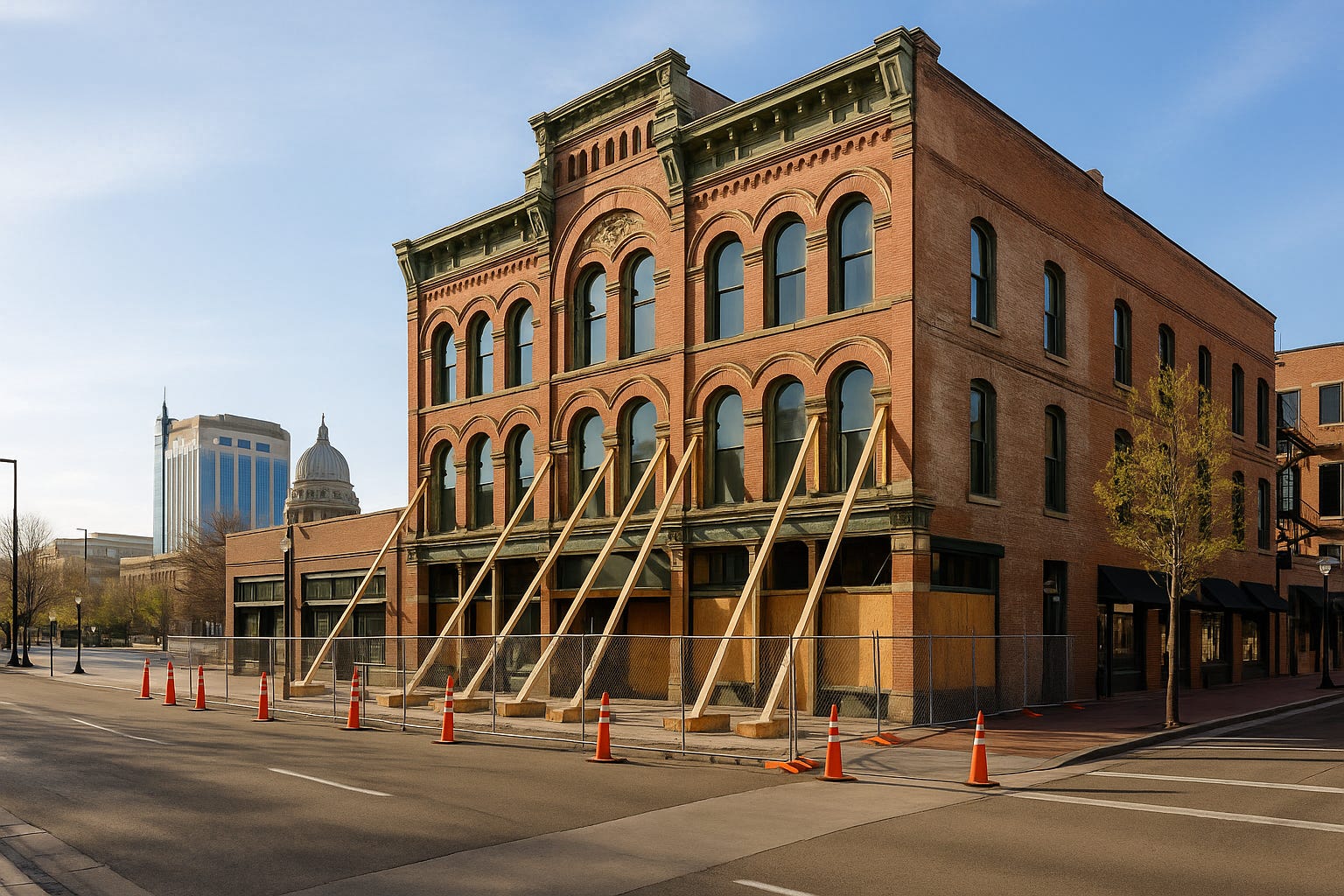
Boise's empty Union Block building is no longer just a closed storefront problem. The downtown landmark's owner has appealed a federal ruling and filed new claims in Ada County District Court, extending a years-long fight over a city safety order that pushed tenants out and kept part of Idaho Street fenced off.
A closed building with a live case
The Union Block sits between Capitol Boulevard and Eighth Street, a high-visibility stretch of downtown Boise where empty doors, fencing and traffic cones have become part of the block. City staff condemned the building in late 2023 after raising structural concerns, including temporary shoring, facade deterioration and other safety issues tied to a long-running renovation.
The building is not a disposable strip mall. Court filings and local reports describe it as more than 120 years old, with a history that reaches back to the earliest built fabric of downtown Boise. It also used to house restaurants and other tenants, which means the fight is not only about one owner and City Hall. It is about whether an older downtown building can be made safe without leaving a working block in suspended animation.
U.S. District Judge David Nye ruled this spring that Boise officials had enough evidence to support the dangerous-building decision and that the city provided process before keeping the building closed. Some claims were left for state court, and the owner has now taken that route while also appealing the federal decision.
Public safety meets property rights
That is the civic pressure point. Boise has an obligation to keep pedestrians, workers and nearby businesses safe if a structure is unstable. A city cannot look at a crumbling facade, shoring concerns and blocked streets and pretend the risk belongs only to the property owner.
But property rights also matter. When a city uses its police power to empty a building, close sidewalks and keep a valuable property out of use, the process has to be tight, transparent and answerable. That is not anti-government. It is how local government keeps public trust, especially in a state where private property and local control are not decorative slogans.
The latest filings keep both questions alive. Was Boise right to keep the building closed under its safety code? Has the owner received the process the law requires? And can either side produce a practical path that protects the public while getting a landmark property repaired instead of trapped?
Downtown needs an ending, not another year of cones
The most practical consequence is on the street. Reports from the area describe sidewalk, lane and alley impacts around the building, and city officials have said they are focused on making the area safe for public use. For downtown workers, nearby businesses and visitors, that is not an abstract courtroom issue. It is a daily reminder that old buildings can become civic bottlenecks when repairs, enforcement and litigation all move at different speeds.
The best outcome is not a symbolic win for either side. It is a safe, usable building or a documented decision that shows why that cannot happen. Boise's older commercial blocks are part of the city's identity, but identity does not fix masonry, reopen sidewalks or bring customers back to storefronts.
This is where accountability has to be visible. If the building can be repaired, the city and the owner need a schedule the public can understand. If it cannot, Boise needs to say what comes next and why. A downtown block should not be left as a warning sign when it could be put back to work.