
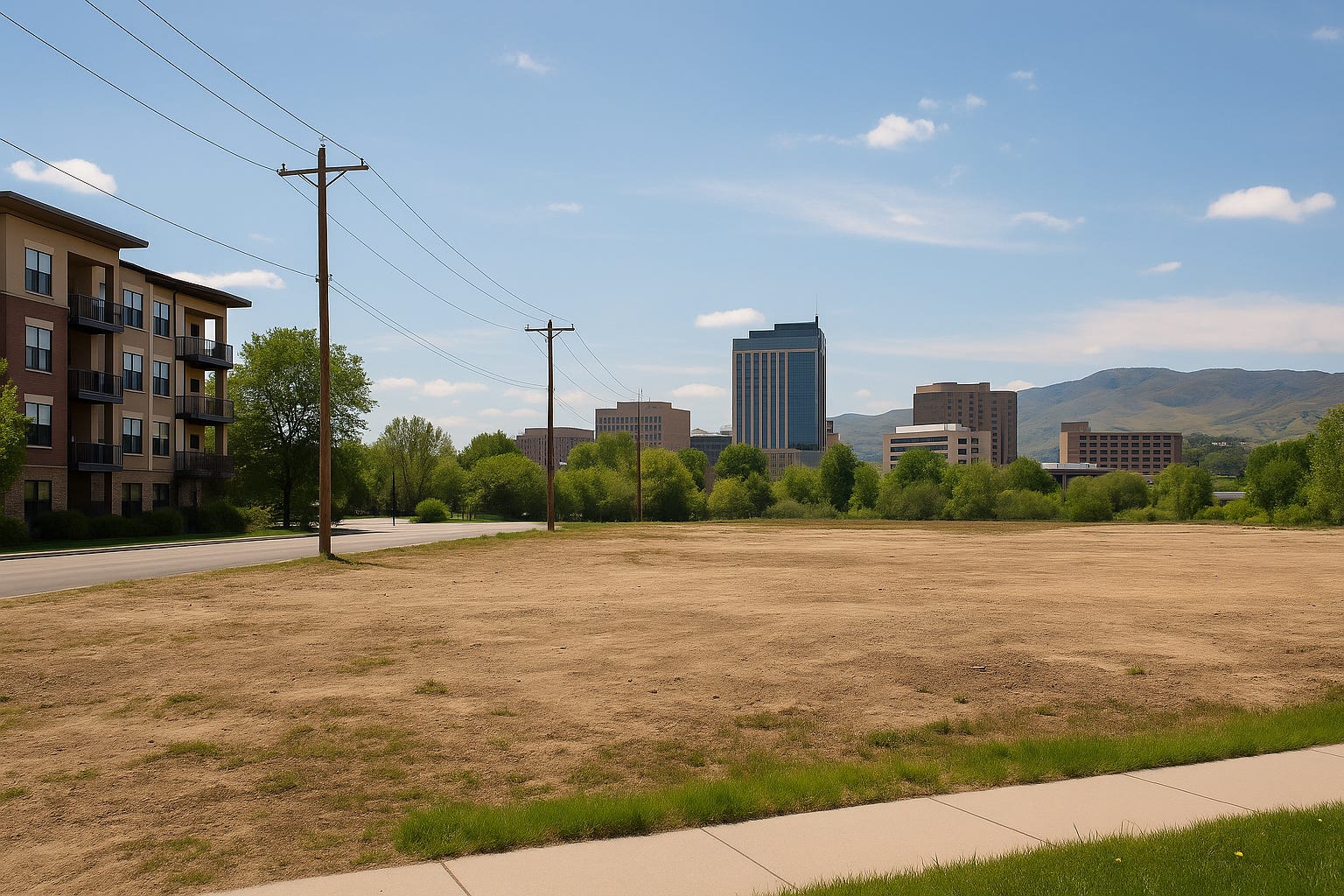
Two downtown Boise land deals have turned River Street into a test of public money, local control and the next shape of the city's events economy. The Greater Boise Auditorium District has secured agreements tied to two neighboring parcels near 9th, 10th and 11th streets, giving the hotel-tax-funded district nearly six acres within walking distance of Boise Centre, the Greenbelt and Ann Morrison Park.
Two parcels near the Greenbelt
The first deal covers 1050 W. River St., at the northeast corner of 11th and River. The district board approved a purchase and sale agreement for that 4.13-acre property at a special meeting on March 31. District materials describe it as a full city block close enough to Boise Centre that the district can plan a future project without closing the existing convention facility.
The second deal followed less than a month later. On April 28, the board approved an option agreement for 970 W. River St., at the northeast corner of 9th and River. That parcel covers 1.84 acres and sits next to the larger 11th Street property. Public reports put the second parcel at just over 80,000 square feet.
Together, the two properties give the district just under six acres in one of the most watched parts of downtown. The land sits near hotels, restaurants, the Greenbelt, cultural venues and major roads. That location is exactly why the decision will matter beyond the meetings-and-conventions world. Any future building could affect traffic, parking, river access, downtown business patterns and the public feel of a fast-changing neighborhood.
A public district with expansion on its mind
The Greater Boise Auditorium District is not a private developer. It is a public auditorium district created by voters in 1959, and its job is to build, operate and manage public gathering places such as auditoriums, exhibit halls, convention centers, sports arenas and similar facilities. Its main asset is Boise Centre, which opened in 1990 and expanded in 2017.
The district says Boise Centre is operating near full capacity. Its own 2025 year-end report says the convention center hosted 278 events and more than 170,000 attendees in fiscal year 2025, producing an estimated $51.2 million in local economic impact. A market and feasibility study by Johnson Consulting identified two main opportunities: expanding Boise Centre so it can host more and larger events, and building an indoor sports facility that could draw regional tourism while serving local recreation demand.
That is the case for growth. The public-accountability question is what Boise gets for the land and money. The district says it receives revenue from a 5% room tax paid by travelers and collected by lodging properties inside district boundaries. Residents do not pay that tax unless they stay in those rooms, but it is still public revenue controlled by a public board.
The next decision is bigger than land
District leaders have not picked a final project, design or construction timeline. That is important. The land is secured before the shape of the next public facility is known. District materials say the added acreage could help with site layout, parking, pedestrian access and keeping a future project from being landlocked. They also say Boise Centre will remain open and existing reservations will be honored.
The board's public calendar shows the River Street decisions moving through regular and special meetings, with agendas, packets, minutes and video posted for public review. That process now needs to stay visible. A six-acre downtown footprint is not just a real estate move. It is a long-term public bet on how Boise handles growth, visitors, work, traffic, family recreation and taxpayer accountability.
That makes the public test straightforward: can the district use room-tax revenue to build something that strengthens downtown, supports small businesses, brings outside dollars into Idaho and respects the people who live and move through the area every day? If costs, access and neighborhood effects become clear only after major decisions are settled, the public will have learned too late.
For Boise residents, the story is not just whether the district owns more land. It is whether a public board can turn that land into a useful civic asset while showing its math in daylight. River Street is now where that test starts.