
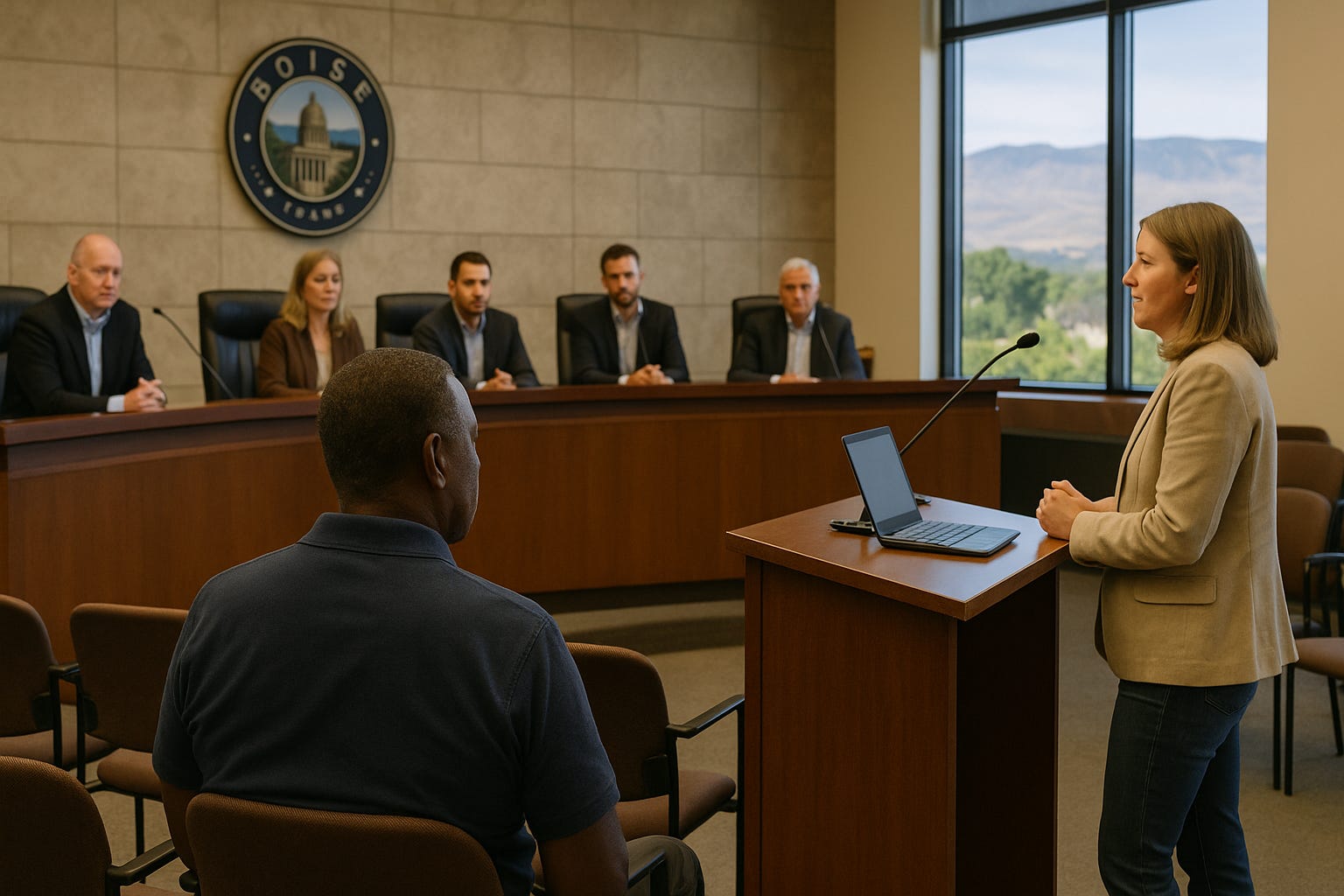
Boise City Council is being pulled back into one of the city’s most contested land-use decisions, this time over whether neighborhood materials were left out of the record before officials approved Interfaith Sanctuary’s State Street shelter home. The council’s June 9 agenda lists CUP25-00022 and CVA25-00028 as an augmentation of the public record, a narrow but consequential step in a case that touches public safety, property concerns, city accountability and how much confidence residents can place in the process.
The missing material now before council
The issue is not a new shelter application from scratch. It is whether the official record was complete when city officials made their earlier decision. An Ada County district court order sent the matter back so the city can add omitted material and decide whether that added record changes the final result.
The material at issue includes a June 20, 2025, report submitted by the Veterans Park Neighborhood Association. Court filings and local reporting describe the omitted materials as including crime data, calls for service statistics and proposed mitigation measures tied to the shelter. Those are not abstract complaints. They go directly to how a shelter home fits into a neighborhood with homes, businesses, traffic, nearby parks and families who expect the city to manage public order with eyes open.
The city has argued the information was already summarized elsewhere in the record and would not have changed the outcome. The neighborhood association has argued the council needed the full submission to weigh neighborhood impacts. On June 9, council members are being asked to approve the record augmentation and determine whether the earlier decision should be modified.
How the shelter approval got here
The city agenda packet says Interfaith Sanctuary Housing Services requested a conditional use permit to operate a shelter home on an approximately two-acre site at 4306 W. State St. The application also included a variance request involving streetscape standards and access and connectivity requirements.
On July 7, 2025, the Planning and Zoning Commission held a public hearing, heard from the applicant, the neighborhood association and members of the public, then voted 4-0 to approve the conditional use permit with conditions and deny the variance. Both sides later appealed parts of that outcome.
The City Council held a lengthy public hearing on Sept. 30, 2025. The city memo says the record before council included more than 24,000 pages and more than 300 written public comments in support and opposition. That scale matters. When a public record gets that large, the trust question is not whether everyone got everything they wanted. It is whether decision-makers had the material they were supposed to have before voting.
Why the neighborhood stakes are bigger than one vote
The State Street site is already being treated by the city as an active neighborhood coordination issue. Boise’s shelter information page says shelter staff will meet regularly with the Boise Police Department and neighborhood stakeholders, with nearby residents, renters, business owners and property owners invited to monthly meetings. The page also says the area is regularly patrolled, a traffic officer has been assigned to the area and police are prepared to add resources if needed.
That kind of coordination is exactly why the omitted record dispute matters. Public safety plans, calls for service, parking rules, property concerns and mitigation steps are not paperwork trivia. They are the terms under which a sensitive public-service project either earns trust or keeps generating friction.
The court did not halt the approvals during the remand process, so the project’s permits remain active while the council reviews the added material. The practical question now is simple: after the missing record is officially considered, does Boise stand by the prior approval, change the conditions or adjust course in some other way?
For taxpayers and neighbors, the answer will say a lot about how Boise handles controversial growth decisions. A city can support shelter services and still owe residents a complete record, a serious public safety plan and a process that does not treat neighborhood concerns as a box to be checked after the fact.