
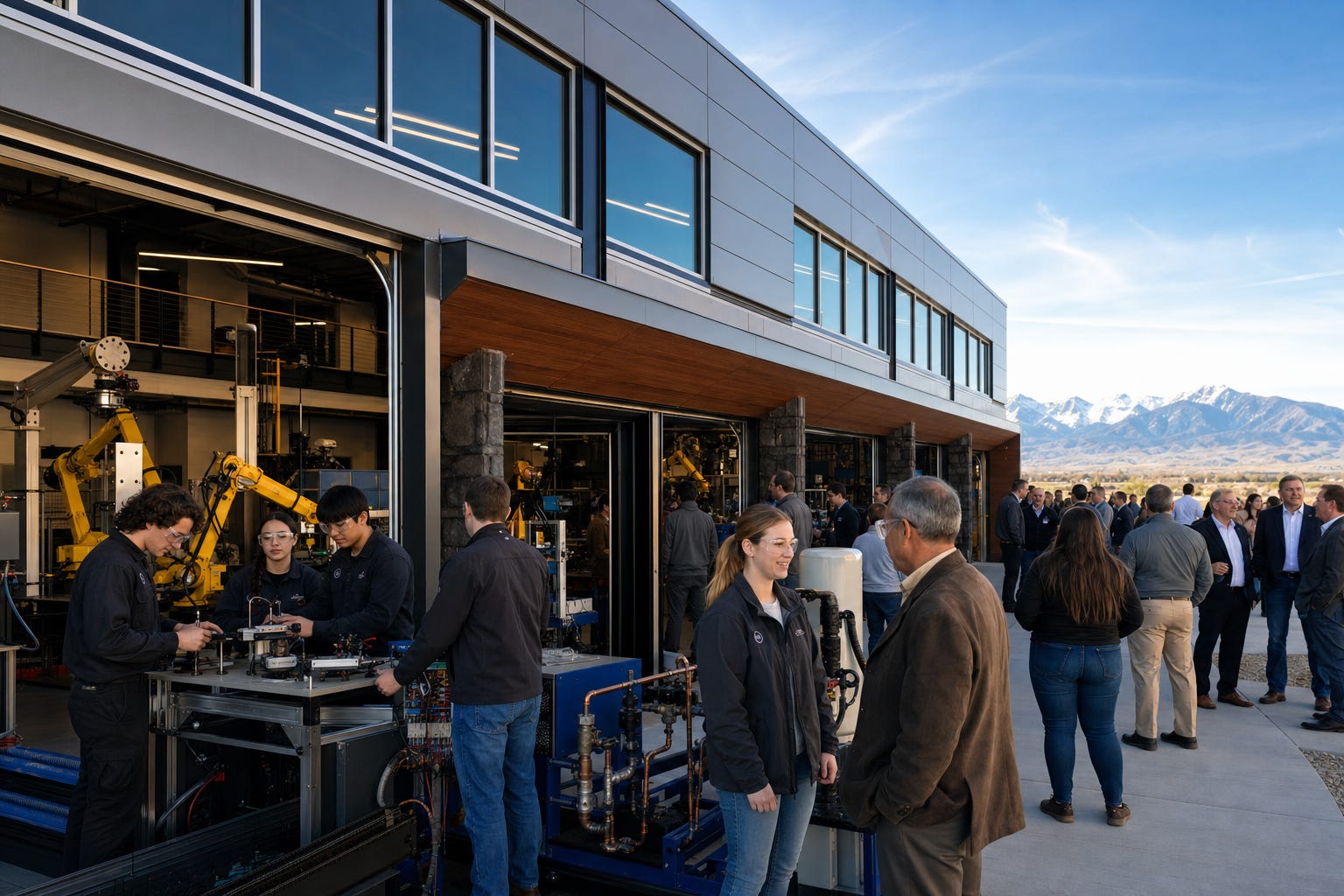
IDAHO FALLS, Idaho. Eastern Idaho's nuclear ambitions now have an 88,000-square-foot classroom. The College of Eastern Idaho opened its $52 million Future Tech Building on Thursday, putting laboratories for cybersecurity, robotics, energy systems and advanced manufacturing under one roof before students arrive Monday.
Gov. Brad Little, U.S. Sen. Jim Risch, Lt. Gov. Scott Bedke and Idaho National Laboratory Director John Wagner joined college and community leaders at the ribbon cutting. Their presence made the stakes plain: Idaho has major energy and technology work in motion, and that work needs a steady supply of people who can build, operate and repair real equipment.
The building is designed around the jobs
The program list ranges from mechatronics and automated systems to cybersecurity, battery technology, engineering, robotics, industrial technology, health physics, computer networking and advanced manufacturing. Agriculture technology and surgical technology will also use the new space.
Inside are hands-on laboratories, collaborative classrooms, a secure operations center and an Applied STEM Institute backed by Battelle Energy Alliance, the contractor that manages Idaho National Laboratory. CEI says the building can add room for roughly 1,000 students, a significant expansion for a college that has been operating with essentially the same physical footprint it had in 2017.
The timing is deliberate. CEI reported a fall headcount of about 1,911 students, 7.7% higher than the prior fall. College President Lori Barber has said employers were invited into curriculum planning so graduates would arrive with skills that match actual openings instead of a generic credential and a hope.
The financing also reflects a broad local bet. CEI says Battelle Energy Alliance invested $5.5 million in the building and the STEM institute. Frontier Credit Union supplied another $3.5 million. It also created a scholarship track for students preparing for STEM careers. College officials said 97 donors helped support the finished project.
The public cost record is visible too. CEI trustees approved a guaranteed maximum of $36.4 million for core construction in 2024. The college now describes the completed building, including its equipment and expanded program space, as a $52 million project.
Nuclear growth needs technicians as much as engineers
Idaho National Laboratory's research may carry the national profile, but much of the work surrounding it depends on technicians and skilled trades. Wagner said the laboratory's current pace has pushed demand for technical talent beyond what it has seen in modern times. The openings extend well beyond nuclear engineers to cybersecurity workers, fabricators, construction crews, health physics specialists and people who understand automated systems.
CEI mechatronics instructor Gary Holyoak described the practical skill stack employers are seeking: electronics, pneumatics, hydraulics, robotics, automation, programming and troubleshooting. When a production or research system stops, the worker who can diagnose the failure becomes immediately valuable.
Retirements add pressure. Holyoak said employers are losing experienced baby boomers faster than the next generation can replace all of them. That turns the new building into more than campus expansion. It is part of eastern Idaho's attempt to keep skilled work local and give young people a route into technical careers without requiring every student to begin with a four-year degree.
The college is also offering a new associate degree in engineering for students who plan to transfer to a university. That creates two lanes from the same building: direct preparation for hands-on jobs and an affordable starting point for students pursuing advanced engineering work.
Risch tied the project to Idaho's energy advantage
Risch used the opening to connect workforce training with Idaho's place in the nuclear industry. He said rising electricity demand from artificial intelligence, data centers and other industries is increasing interest in nuclear power, and argued that Idaho Falls should remain central to that national conversation.
His point was concrete. A reactor program cannot expand on scientists alone. It also needs people who can wire controls, secure networks, test components, maintain machines and solve failures safely. The new classrooms put those disciplines within reach of Idaho students and closer to the employers already asking for them.
Battelle reinforced that link at the ceremony with another $1 million installment toward its contribution. Students will enter the facility as CEI's fall semester begins Monday, moving the project from ribbon-cutting language to daily instruction almost immediately.
The real test starts with the first class
The building is finished. The equipment is moving into use. What follows is the harder measure: whether CEI can turn employer requests into capable graduates quickly enough for a growing regional economy.
For Idaho families, the payoff is practical. More training capacity can mean more paths into skilled work close to home. For employers and taxpayers, it can mean that major investments in energy, manufacturing and technology are supported by workers trained in the communities where those investments land.
Idaho does not keep its nuclear advantage by owning a map pin. It keeps it by training people who can do the work.