
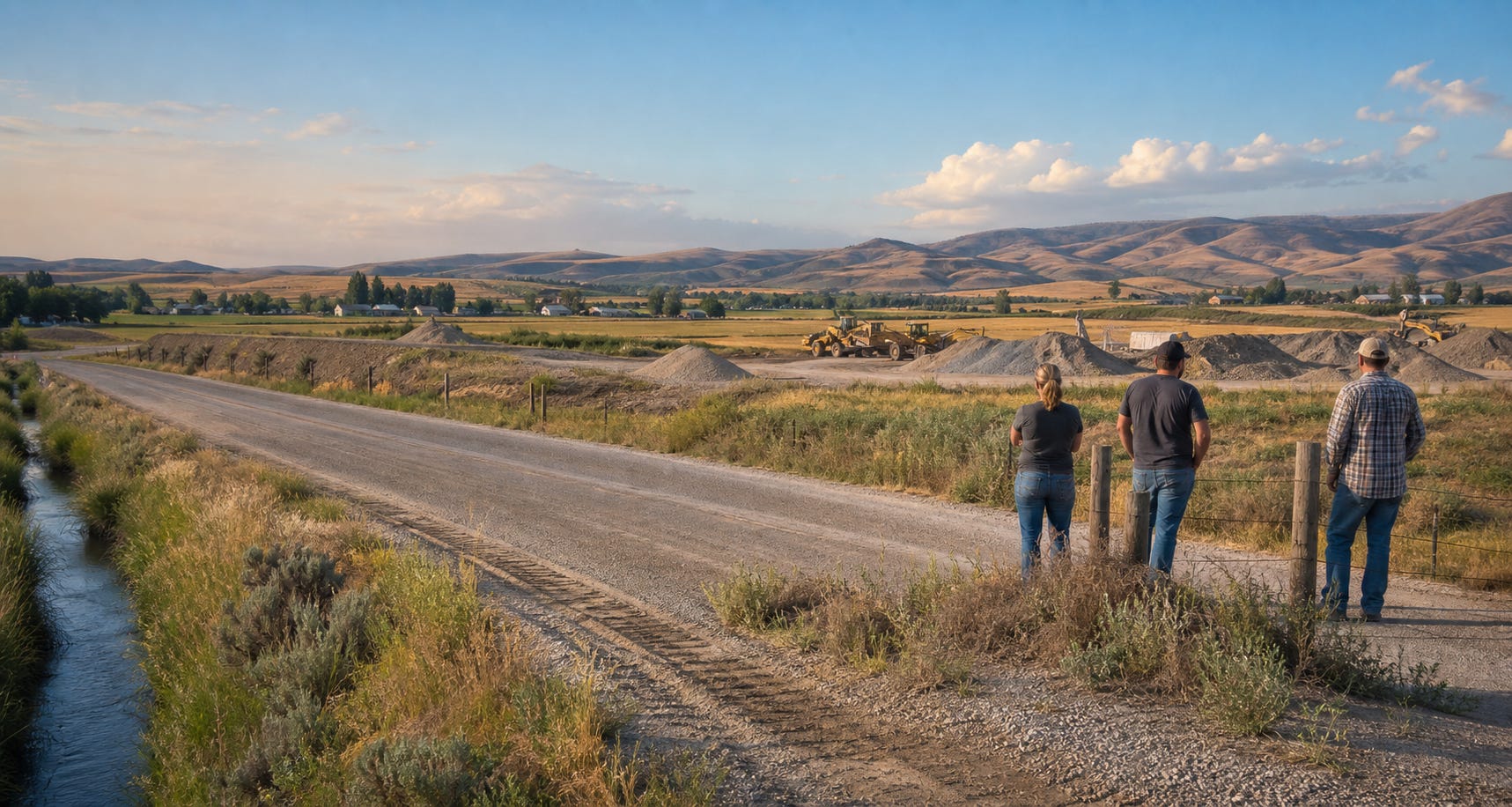
Gem County commissioners have approved Merrill's Pit, a proposed 393-acre gravel operation near Star Lane and Sales Yard Road outside Emmett, after months of public argument over roads, dust, property values and water monitoring. The vote gives Granite Excavation a path forward, but not a blank check. Conditions tied to dust control, Star Lane, highway access, berms, setbacks and monitoring wells now become the real local accountability test.
A gravel decision with road conditions attached
The county's decision came after a public hearing that had already closed on April 7, meaning the latest session was for deliberation and a decision rather than a fresh round of testimony. Commissioners worked through the required county findings before voting, with Commissioner Defer excused from the matter and Commissioners Kirk Wille and Mark Rekow discussing the application before a unanimous vote.
The approval matters because gravel is not an abstract land-use category in a growing Idaho county. It is the material under roads, homes, subdivisions and public projects. It is also heavy truck traffic, dust, noise and wear on rural lanes that families use every day. That is why the conditions are the story.
Before Phase 1 can begin, the project is expected to clear several gates: approved plans for Star Lane, state permission for the highway access point and a settled agreement on road mitigation. Those requirements put the burden where it belongs: not on neighbors to hope for the best, but on the operator and county to prove the roads can handle the use before hauling scales up.
Neighbors are watching enforcement
Residents near the site have raised concerns for months about dust, road safety, property values and whether a rural community can absorb an industrial use of this size without losing the character that brought people there. Earlier hearings drew large crowds, with neighbors pointing to truck traffic near Emmett High School, the limits of Star Lane and the long-term effect on nearby homes.
The final approval adds new conditions on dust control, roads, setbacks, berms and water monitoring. Commissioners required continuous watering during crushing operations. They also required Granite Excavation to add three more water-monitoring wells, bringing the total to five, and real-time data access was discussed as a way for the company, county and possibly other agencies to see water conditions instead of relying only on after-the-fact assurances.
That is the practical question now. A permit condition is only as strong as the person who checks it, the timeline that triggers it and the consequence when it is missed. If the county keeps the road, dust and water requirements visible, enforceable and tied to operations, the approval can be judged by performance. If not, the neighbors' concern about promises outlasting oversight will get louder.
Growth still has to fit the ground
Granite Excavation has argued that the process has been thorough and that the company can operate responsibly. Neighbors have said they are not against construction work or local jobs, but they want the location, roads and safeguards treated seriously. Both points can be true. Idaho needs builders, materials and private businesses that can keep up with growth. Idaho also needs counties willing to defend private property, rural roads and public order when growth pushes into neighborhoods.
That makes Merrill's Pit bigger than one permit. It is a test of whether a rural county can say yes to a needed industry without turning local control into paperwork. The vote is finished. The accountability part is just starting.