
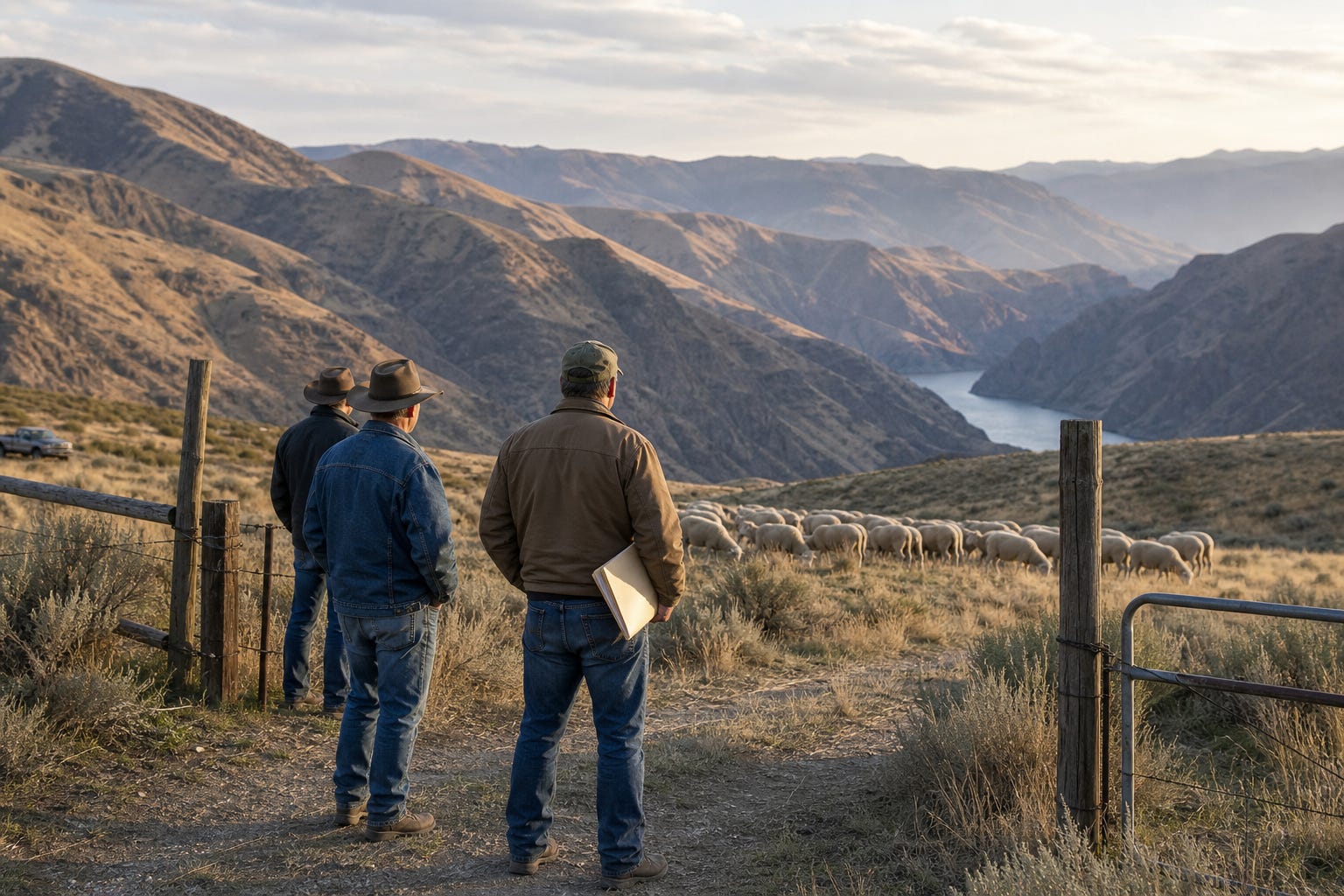
Idaho lawmakers have reopened a Hells Canyon grazing fight that has outlasted two major court rulings, reduced the working range of family sheep outfits and left a 1997 government letter at the center of a basic Idaho question: who carries the cost when wildlife policy changes the use of federal land?
At a July 23 meeting of the Legislature's Committee on Federalism, longtime ranchers from Soulen Livestock and Shirts Brothers Sheep put payroll, flock size and grazing access behind a dispute that can otherwise sound like paperwork. The committee responded by voting to press state and federal agencies over commitments made nearly three decades ago.
Ranch families put a cost on the conflict
The committee's official agenda reserved 90 minutes for domestic sheep issues on federal land allotments. Ranchers, an attorney and a livestock researcher were invited to address permits, lawsuits and disease studies.
Harry Soulen told lawmakers that his operation cut its sheep numbers in half and released six employees after grazing access was reduced. Ron Shirts said restrictions left his family unable to run two of its three sheep bands on the affected ground. He carried in a briefcase of case records that he said had not been opened for 17 years, underscoring how long the dispute has followed the families involved.
Those are not abstract costs. They are fewer working animals, fewer rural jobs and less room for multigenerational ranches to absorb drought, feed prices and other pressures. The conflict also puts local control in an awkward place because the grazing permits are federal while the wildlife restoration effort included Idaho agencies.
A state court drew a hard legal line
The central document is a January 1997 letter from the Hells Canyon Bighorn Sheep Restoration Committee. The group included wildlife agencies from Idaho, Oregon and Washington, along with federal partners. It recognized existing livestock operations and said state wildlife departments would handle losses and disease spread among reintroduced bighorns without taking action that harmed established domestic sheep operators.
Ranchers viewed that language as protection for operations already using the country. The Idaho Supreme Court later gave it a narrower meaning. In a 2012 case brought by the Idaho Wool Growers Association and members of the Shirts family, the court affirmed dismissal of claims seeking compensation from the state for losses tied to Forest Service permit changes.
The justices concluded that the letter did not require Idaho Fish and Game to shield or reimburse ranchers for decisions made by an independent federal agency. They also ruled that Idaho law did not create a right to payment for those losses. That decision remains a major limit on what the old letter can accomplish by itself.
Current Idaho law still gives ranchers a formal place in bighorn relocation decisions. It requires notice to county commissioners, affected grazing permit holders and nearby landowners. It also provides a hearing process, requires written recognition of existing livestock operations and directs wildlife managers to consider active sheep allotments while developing best practices.
Federal judges backed the forest decision
A separate federal case established the other side of the boundary. In 2016, the Ninth Circuit upheld a Forest Service decision that closed about 70 percent of the Payette National Forest allotments where domestic sheep grazing had been allowed. The agency's selected plan ended grazing on roughly 69,000 acres over three years.
The Forest Service based its decision on the risk that contact between domestic sheep and bighorns could spread bacteria linked to severe pneumonia outbreaks. Its modeling drew on more than 54,000 location records gathered over 12 years from more than 400 radio-collared bighorns. The appeals court acknowledged uncertainty about the precise mechanics of transmission but found that the agency's analysis was not arbitrary or capricious.
That ruling means a state letter cannot simply reopen federal acreage. It also explains why any durable answer must address both parts of the record: the documented wildlife risk and the documented cost borne by working ranches. Ignoring either one would invite another round of litigation instead of a stable policy.
Lawmakers chose a first step, not a final fix
The Committee on Federalism adopted a motion from Republican Sen. Mark Harris of Soda Springs to send state and federal officials a letter calling their attention back to the 1997 commitments. Republican Rep. Charlie Shepherd of Pollock also asked whether lawmakers could revisit a 2009 legislative approach to the conflict.
That puts the issue back on Idaho's public agenda, but the committee did not approve a bill, replacement grazing plan or financial remedy at the meeting. The immediate action is a request for accountability. The harder work comes next.
The public record now gives lawmakers a clear test. Idaho can defend bighorn herds while insisting that farm families, rural jobs and existing operations count in the decision, as state law already directs. The 1997 letter got ranchers back in the room. The next move will be judged by whether it changes anything on the range.