
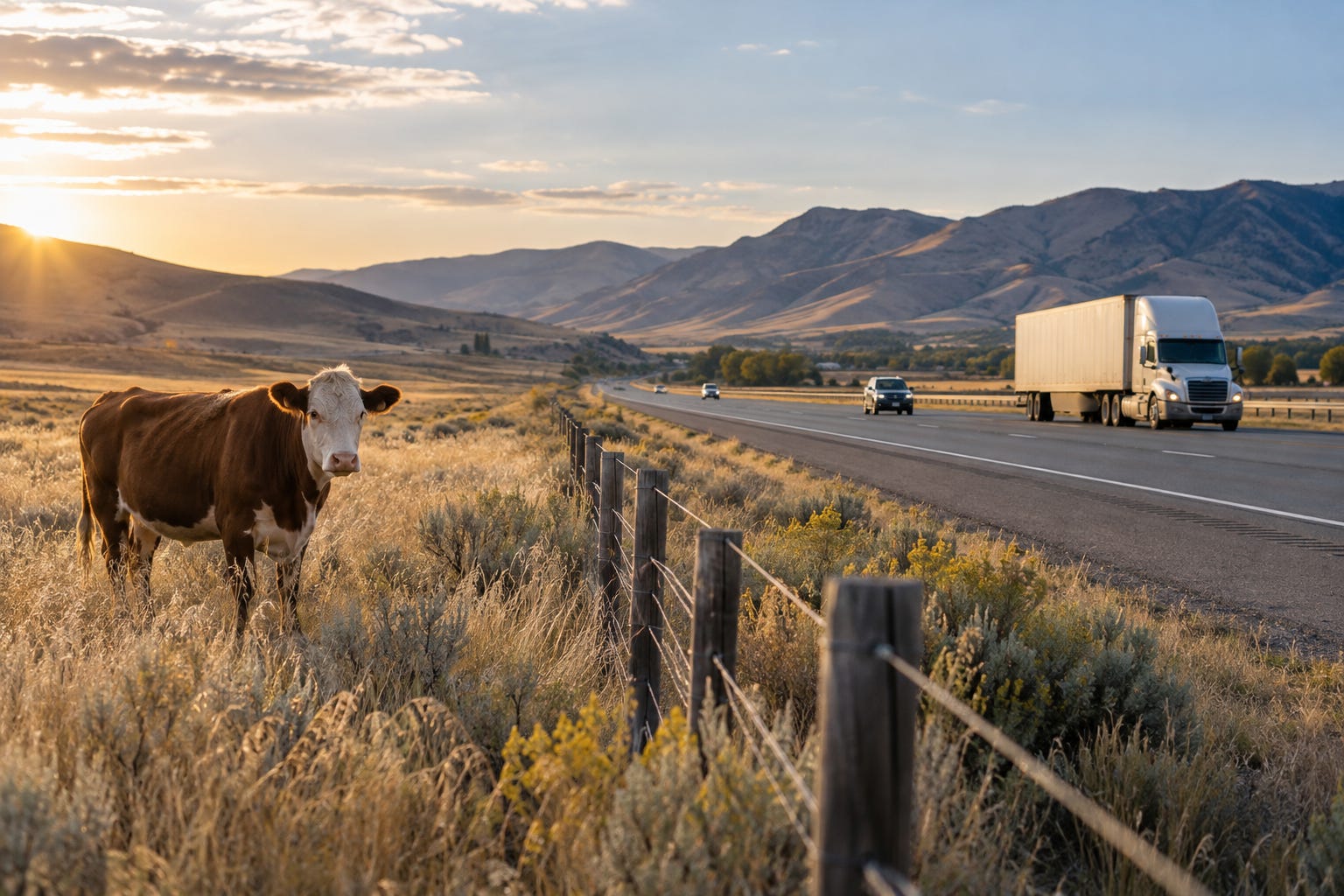
A fence along Interstate 84 does not change Idaho's open-range law, the Idaho Supreme Court ruled Tuesday, ending a driver's bid to hold a rancher and the Idaho Transportation Department responsible for a nighttime collision with a cow in Elmore County.
The vote was unanimous. Writing for the court, Justice Cynthia K.C. Meyer said a single question decides whether a stretch of road is open range: does it sit outside a city, a village or a herd district? Whether the road is fenced, how fast traffic moves on it, and whether it is a federal interstate or a county road do not change that test. Chief Justice Robyn Brody and Justices G. Richard Bevan, Gregory Moeller and Colleen Zahn joined the opinion.
The decision upholds the lower court's judgment for rancher Robert "Bob" Howard and for the transportation department. It also covers Howard Grazing Association LLC, the named holder of the grazing permits near the crash site. The justices awarded the defendants their costs on appeal.
A hole in the fence near a cattle tunnel
The case grew out of a 2019 wreck. Isaac Ludwig was driving east on I-84 at night, through a construction zone, when he came upon one of Howard's cows in the roadway and hit it. He was badly hurt, and his vehicle could not be repaired.
The transportation department maintains fencing on both sides of the freeway along the edge of its right-of-way there. It also keeps cattle guards on the ramps at the two closest interchanges. Department policy describes that fencing as a way to mark the state's control of access to the highway, one that can also cut down on encroachment.
Cattle in the area also have their own route under the road. The Hot Creek Tunnel, a large culvert beneath the interstate, lets livestock move between grazing allotments on either side. Howard has kept the tunnel gated for more than 20 years to control those crossings. In March 2019, state crews cleared brush from the culvert at Howard's request, and on March 30 of that year livestock were herded through it. Some time after that, one of his cows ended up on the freeway.
When Howard checked the fence on the north side of the freeway the next day, he found a gap roughly 100 yards from the mouth of the tunnel.
Ludwig sued in 2021 for negligence and recklessness. His complaint said that Howard and the grazing association let the cow wander onto the interstate, that the department did not keep safe, design-compliant fencing along a federal highway, and that all of them failed to warn him the animal was blocking the eastbound lanes.
The trial court in Elmore County twice refused to throw out the claims against Howard and the grazing association, citing factual disputes over the fencing. It later changed course under a 2007 Supreme Court precedent and, on a separate motion, also ruled for the transportation department. Final judgment came April 3, 2024, and Ludwig appealed that July.
Why the fence did not change the answer
Idaho Code 25-2118, on the books since 1961, says the owner of a domestic animal running on open range has no duty to keep it off any highway on that range, and is not liable for vehicle damage or injuries caused when a vehicle hits the animal. The law defines open range as unenclosed land outside cities, villages and herd districts where cattle graze or roam by custom, license, lease or permit.
Ludwig argued that the state's fence line and the ramp cattle guards made this stretch of I-84 enclosed land, which would put it outside the immunity. He also stressed that the crash happened on an interstate with an 80 mph speed limit, not a two-lane county road.
The justices pointed to Moreland v. Adams, the 2007 case in which motorcyclist Rodney Moreland died after hitting a calf on a road with corrals and fencing in some places alongside it. In Moreland, the court refused to read the statute's word "uninclosed" as a separate requirement that would strip immunity wherever a fence stands. That reading, the court warned then, would make ranchers wary of building any fence and would let every fence line work like a herd district.
The court instead read the word as protection for landowners who fence livestock out of their own property. If cattle get into land its owner fenced to keep them out, the livestock owner can still be liable for the damage they do. The trial judge in Ludwig's case made the same point, noting that the fence-out rule would matter only if the cow had damaged fenced state property.
Ludwig did not ask the court to overrule Moreland. Meyer noted that the statute covers "any highway" on open range without carving out interstates or high-speed roads, and wrote that it was "unclear" why either detail should make a difference. Because Ludwig never showed that the crash site lay inside a city, village or herd district, the immunity held.
His argument that federal highway law overrides Idaho's statute also failed, on procedure: he never filed the supporting briefs that court rules require, and he did not contest that ruling on appeal.
The state's highway duty runs to the public
The transportation department won on a different principle, known as the public duty rule. State law makes the department responsible for maintaining state highways, and federal law imposes a similar duty on federally funded projects. But the court said those duties are owed to the public at large, not to a particular class of drivers, so a breach does not by itself give an individual motorist a claim.
The justices also found no special relationship between the department and Ludwig. They said Ludwig had not shown that the department knew how Howard planned to manage his cattle on the day of the crash. The brush clearing did not create a new safety duty either, the court said, because crews did that work to help the rancher move cattle through the culvert, not to make travel safer.
Ludwig also argued the department should have warned drivers, saying it knew or should have known that splitting cows and calves across the interstate was dangerous and that the tunnel gates raised the odds of a cow pushing through the fence. The court said he offered not "a scintilla of evidence" that the department knew, or should have known, of either risk or of a broken fence. The department had also argued that the Idaho Driver's Manual already warns drivers about livestock on the roads.
Because the department owed Ludwig no duty in tort, the justices did not reach its separate design immunity and discretionary function immunity defenses.
Where Idaho law lets communities draw the line
Under the court's test, the line between open range and fenced-in livestock is drawn by herd districts, and Idaho law treats that line as a matter of local control. Idaho Code 25-2402 lets a majority of the owners of taxable real property in a defined area who also live in Idaho petition their county commissioners to create, change or eliminate a herd district. Inside a herd district, the covered animals may not run at large, and owners take on a duty to keep them fenced. The same statute says forming a herd district cannot make the state, a county, a city or a highway district liable for injuries, deaths or property damage caused by livestock on a public right-of-way.
Outside those districts, cities and villages, Idaho's open-range rule applies, freeway fences included. For anyone driving through Idaho ranch country after dark, the practical point is simple: on open range, the rancher has no legal duty to keep cattle off the highway, even where the state has built a fence along the road.