
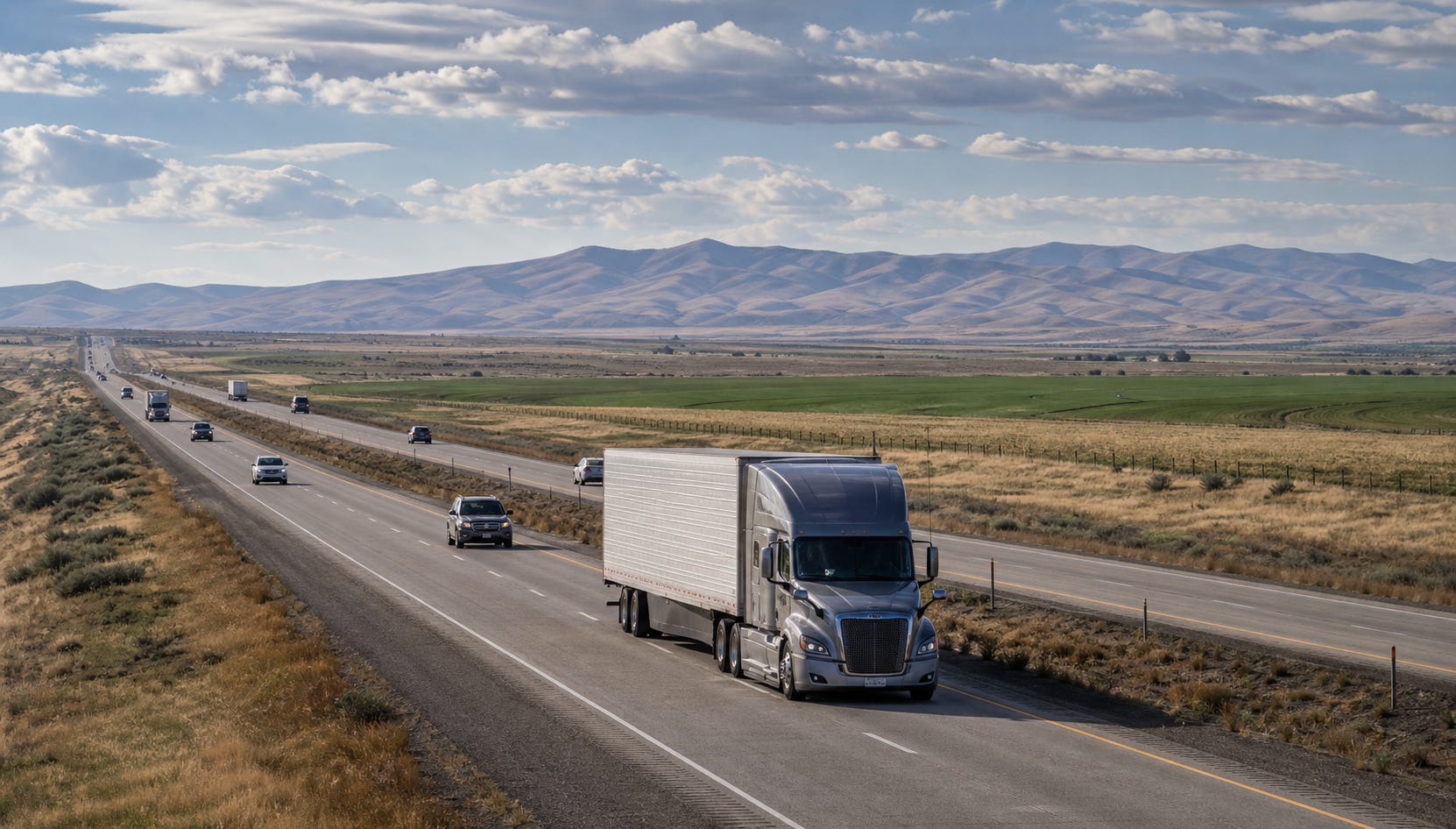
Idaho's interstate rulebook changes July 1: heavy trucks with five or more axles and more than 26,000 pounds will move under the same posted speed limit as other vehicles. On rural stretches where cars can run 80 mph, the new law means big rigs may be allowed to run 80 too, turning a Statehouse vote into a daily road test for families, freight haulers and anyone who uses I-84, I-15 or I-86.
What the new law changes
House Bill 664 amends Idaho's speed-limit statute so the state's biggest highway vehicles no longer sit under a separate truck-only limit when the posted limit for other traffic is higher. Gov. Brad Little signed the measure March 23, and the Legislature lists it as Session Law Chapter 108 with a July 1, 2026, effective date.
The law applies to vehicles with five or more axles operating at more than 26,000 pounds. That is the lane where long-haul freight, farm shipments and commercial rigs meet ordinary Idaho drivers heading to work, church, school events or summer travel.
Idaho has used split limits for years. A 2014 Idaho Transportation Department announcement put most rural stretches of I-15, I-84 and I-86 at 80 mph for vehicle traffic and 70 mph for trucks, while urban interstate sections through places such as the Treasure Valley stayed lower. H0664 removes that split where state speed postings otherwise differ.
Why supporters pushed it
The bill's official statement of purpose makes a simple argument: traffic gets rougher when vehicles are moving at meaningfully different speeds. Supporters cited research saying a 10 mph speed difference can increase vehicle interactions by as much as 227 percent.
Rep. Doug Pickett, R-Oakley, carried the bill on the House floor, and lawmakers moved it with broad margins. The House passed it 57-11-2, and the Senate passed it 27-7-1 before it went to Little's desk. That does not make the change risk-free, but it does show the policy was not a narrow committee experiment.
The public-safety theory is easy to understand. A truck running 10 mph below a stream of passenger cars forces more passing, more lane changes and more blind-spot decisions. At interstate speeds, every extra merge asks families and professional drivers to make the right call fast.
What families will notice on the road
Not every semi will suddenly run 80. A long-haul trucker interviewed along I-84 said many trucks are governed around 65 to 68 mph by company systems or by what they are hauling. The new law gives legal room, but it does not erase equipment limits, grades, weather, construction zones or Idaho's basic rule that drivers must travel at a reasonable and prudent speed for conditions.
That is where the policy meets real life. A fully loaded trailer approaching at 80 feels different from a compact car doing the same speed. Drivers who favored the old split worry about reaction time, passing in the left lane and motorists who dart around slower trucks. Supporters answer that one posted limit may reduce the speed mismatch that creates those maneuvers in the first place.
Idaho is about to test which effect people feel more.
The taxpayer and enforcement test
The fiscal note says H0664 causes no increase or decrease in state or local revenue, though truck-specific speed signs will have to come down. That is the small taxpayer item. The larger public-order test is whether one rule is clearer for drivers and cleaner for enforcement.
Police, sheriff's deputies and state troopers will still have to deal with unsafe passing, following too closely and speed too fast for conditions. The difference is that the roadside conversation will focus less on a separate truck number and more on whether the driver handled the conditions responsibly.
Freight is not an abstraction in Idaho. Food, construction supplies, farm gear and local goods move on these highways every day. Families use the same pavement. If the law smooths traffic without making crashes worse, it will look like a practical road fix. If the first summer brings more tense passes around big rigs, lawmakers should hear about it quickly.
I’m concerned with the mass of a semi moving at 80mph. I don’t know the math but if a sudden need to slow down or brake will take longer than an auto. Many people are taught not to drive too close to semis. That means decrease the following distance or risk passing a truck at speeds over 90mph and maintain that speed for a short while. Drivers education taught us to avoid the clustering of cars. With semis now involved with these clusters seems ripe for an accident. Was there a substantial body of evidence on the dangers or benefits of this bill or was it primarily a political decision? I’m surprised this bill was passed with very little opposition.