
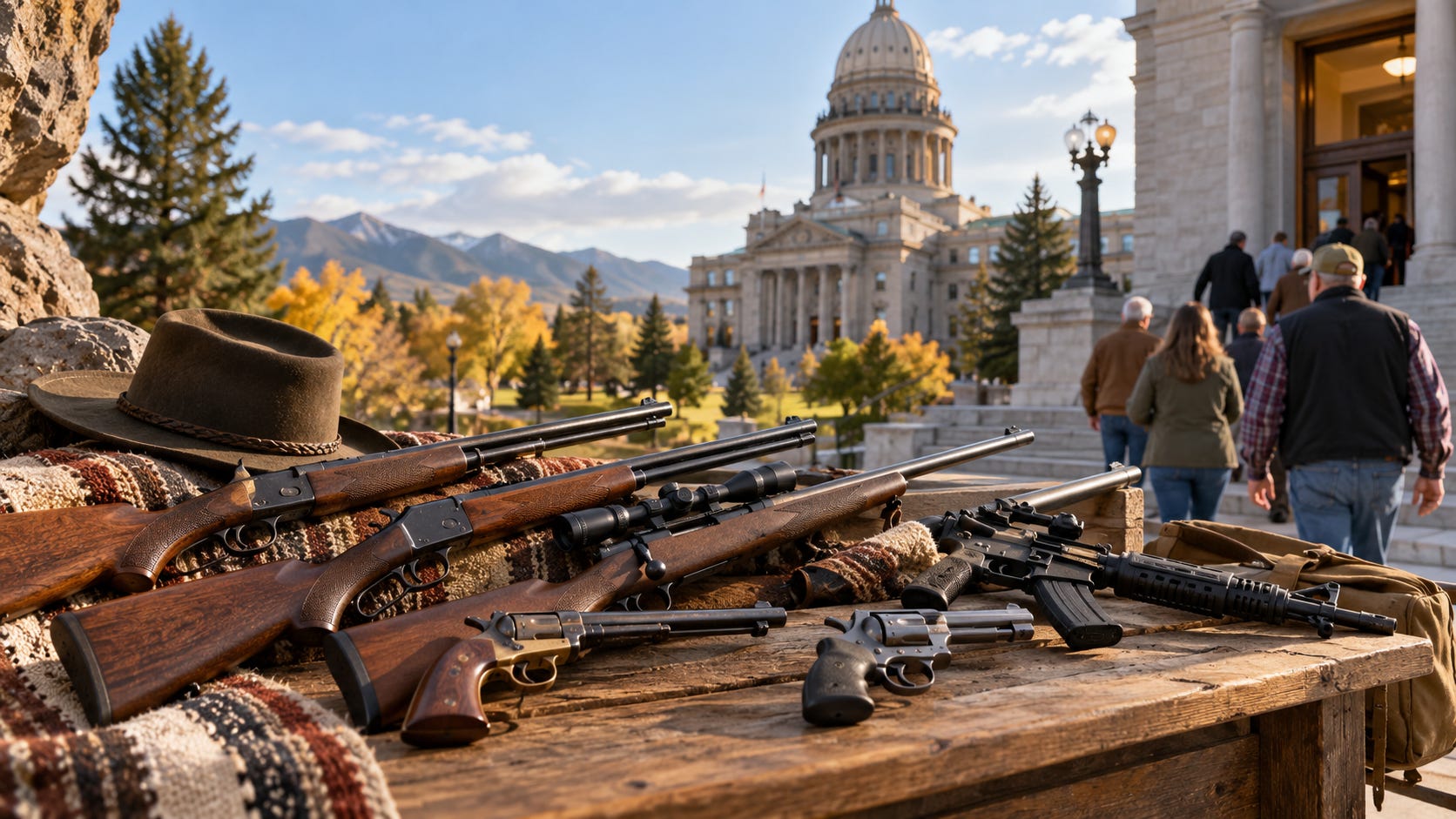
Idaho voters will find an unusual contest on their Nov. 3 ballot: a choice among six firearms, from a frontier-era revolver to a military rifle. They are being asked which one should represent Idaho as its official state gun.
There is a limit to that choice. The election will register a preference, not confer the title. Even the firearm that draws the most support would need a separate legislative designation before becoming an official state symbol.
House Bill 932, signed by Gov. Brad Little on April 2, created the advisory question. Its instructions call for a single selection among the named guns. The measure does not change rules for buying, carrying or using a firearm.
The choices span frontier and military history
The Winchester Model 1894 appears on the ballot with the .30-30 cartridge. The rifle arrived in 1894, while Winchester dates the cartridge to the following year. It represents the lever-action hunting tradition that lawmakers cited when explaining Idaho's connection to firearms.
Another lever-action option reaches further back: Winchester's Model 1873, listed in .44-40. Its familiar nickname, "Gun that Won the West," appears in the question itself. The model's history is tied to the expansion of frontier settlement.
Voters who prefer a revolver have the Colt Single Action Army, introduced in 1873 and identified on the ballot in .45 Colt. The "Peacemaker" name accompanies that choice. Its early users included military personnel as well as civilians and law enforcement.
The military-history choices also include the M1 Garand, listed in .30-06. The National Park Service's Springfield Armory history dates the Army's adoption to 1936 and its replacement by the M14 to 1957. The Colt M1911 pistol, identified in .45 ACP, became a U.S. military sidearm in 1911 and later found civilian uses in defensive carry and competitive shooting.
The Remington Model 700 rounds out the ballot. This bolt-action rifle was introduced in 1962; the question specifies .30-06. Its history includes civilian shooting and military applications, with the Model 700 action forming the basis of the Army's M24 system.
Together, the options cover different parts of the history lawmakers want the symbol to recognize. The ballot specifies a particular model and cartridge for each choice, rather than asking voters to choose a manufacturer generally.
Monks carried the proposal to a unanimous House vote
Rep. Jason Monks was the House floor sponsor of the measure. It cleared that chamber on March 20 with 68 votes in favor, none against and two members absent. Sen. Mark Harris carried it on the Senate floor, where the March 31 vote was 32 in favor and none opposed, with three senators absent and excused.
Little's signature made the act effective April 2. Rather than naming a gun in that law, lawmakers handed the preference question to Idaho's electorate.
The bill connects the proposal to the 250th anniversary of American independence. Its findings describe firearms in Idaho's exploration, gold-rush settlements and agricultural life, including their use by ranchers and farmers. Hunting and recreational shooting are also part of the Legislature's stated rationale.
A preference vote leaves the final designation to lawmakers
For taxpayers, the accompanying fiscal note projected minimal added election expense. It said the Secretary of State already had enough funding to place measures on the ballot and anticipated no direct effect on state General Fund or local revenues. That document provides no dollar estimate and was prepared by a bill proponent, not as an independent accounting of final costs.
HB 932 directs the Secretary of State to tabulate the answers. It does not set a deadline for lawmakers to turn the result into a designation, and its statement of purpose expressly anticipates action in a later legislative session.
November's choice is therefore about Idaho identity, not a new firearm restriction or permission. Voters can tell lawmakers which piece of hunting, frontier or military history they prefer. Making that preference an official state symbol remains the Legislature's next decision.