
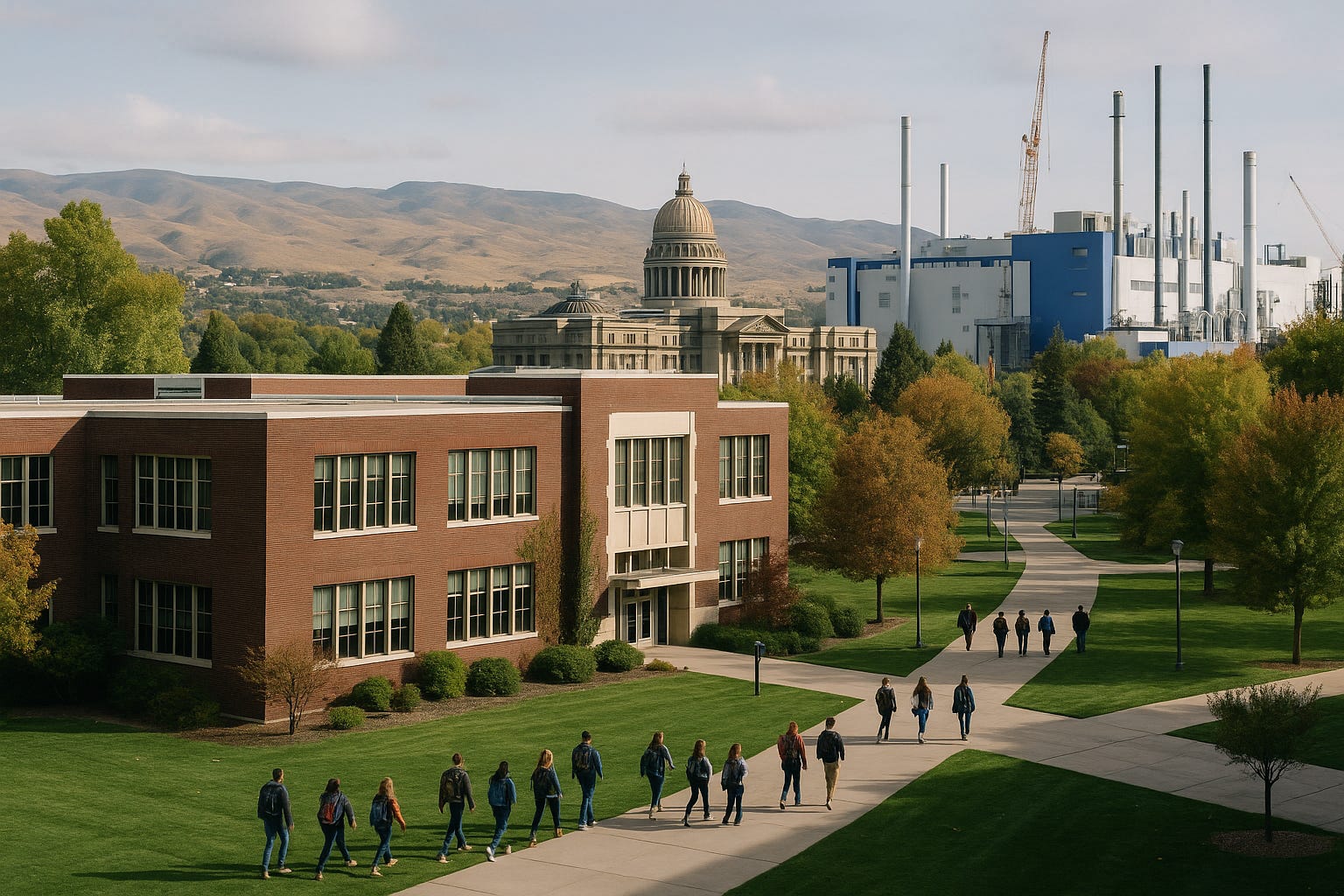
Boise State University is now the lead institution for a new Pacific-Intermountain semiconductor workforce network, putting Idaho at the center of a nine-state push to turn chip manufacturing growth into local jobs, student pathways and a stronger advanced-manufacturing base.
A nine-state pipeline starts in Boise
The Pacific-Intermountain Network for Education in Semiconductors is a regional node of the National Network for Microelectronics Education, a national effort supported by the National Science Foundation in partnership with the U.S. Department of Commerce and aligned with the CHIPS and Science Act.
Boise State announced the selection during a campus launch event with Gov. Brad Little, national science officials and industry partners. Little called the selection a major win for Idaho's economy and said the collaboration can help companies grow, attract investment and keep the region competitive.
The network will be led through Boise State's Microelectronics Education and Research Center in the College of Engineering. Its territory covers Idaho, Montana, Washington, Oregon, Northern California, Colorado, Utah, Nevada and Hawaii. Boise State says the regional coalition includes universities, community colleges, K-12 partners, corporations, workforce groups and government organizations.
The local lineup matters. Idaho partners named for the effort include the University of Idaho, Idaho State University, Northwest Nazarene University, BYU-Idaho, the College of Eastern Idaho, the College of Southern Idaho and the College of Western Idaho. That gives the project a statewide reach, not just a Boise campus address.
Micron's expansion makes training practical
The timing is not accidental. Micron is building out a massive expansion at its Boise headquarters campus, with the company previously putting the investment across two new fabs at about $50 billion. The first fab is expected to include a 600,000-square-foot cleanroom, with equipment moving in later this year and first wafer production targeted for mid-2027. A second fab is planned to become operational near the end of 2028.
The company has projected more than 4,000 jobs tied to the two new fabs, plus growth among suppliers and other employers around the Treasure Valley. That is the practical reason this workforce network is more than a ribbon-cutting. If Idaho cannot train technicians, engineers and support workers fast enough, the biggest industrial project in the state becomes a missed local opportunity.
Micron is also preparing a new training center near the old Boise Factory Outlets mall, working with suppliers and the College of Western Idaho to train technicians for equipment work. The company has pointed to a summer opening for that center.
The taxpayer test is local payoff
The new regional node is one of only four selected nationally, and Boise State says it is one of only two higher education institutions serving as a regional lead. Under the national structure, the SEMI Foundation and NSF anticipate potential support for each regional node of up to $20 million over five years, based on performance.
That puts a clear public test on the project. Idaho families, taxpayers and students should see more than headlines about high-tech growth. They should see clearer career pathways, more hands-on training and a shot at high-wage work without leaving the state.
Boise State says its microelectronics programs have already reached more than 25,000 K-12 students, enhanced coursework for more than 3,000 Boise State students and trained more than 150 educators to bring semiconductor concepts into classrooms. The new network is meant to scale that work across schools, colleges, apprenticeships, internships and employer partnerships.
For Idaho, the bet is simple. Micron can build the fabs. The state now has to build the workforce around them. If the pipeline works, more of the value from the chip boom stays with Idaho workers, Idaho schools and Idaho communities.