
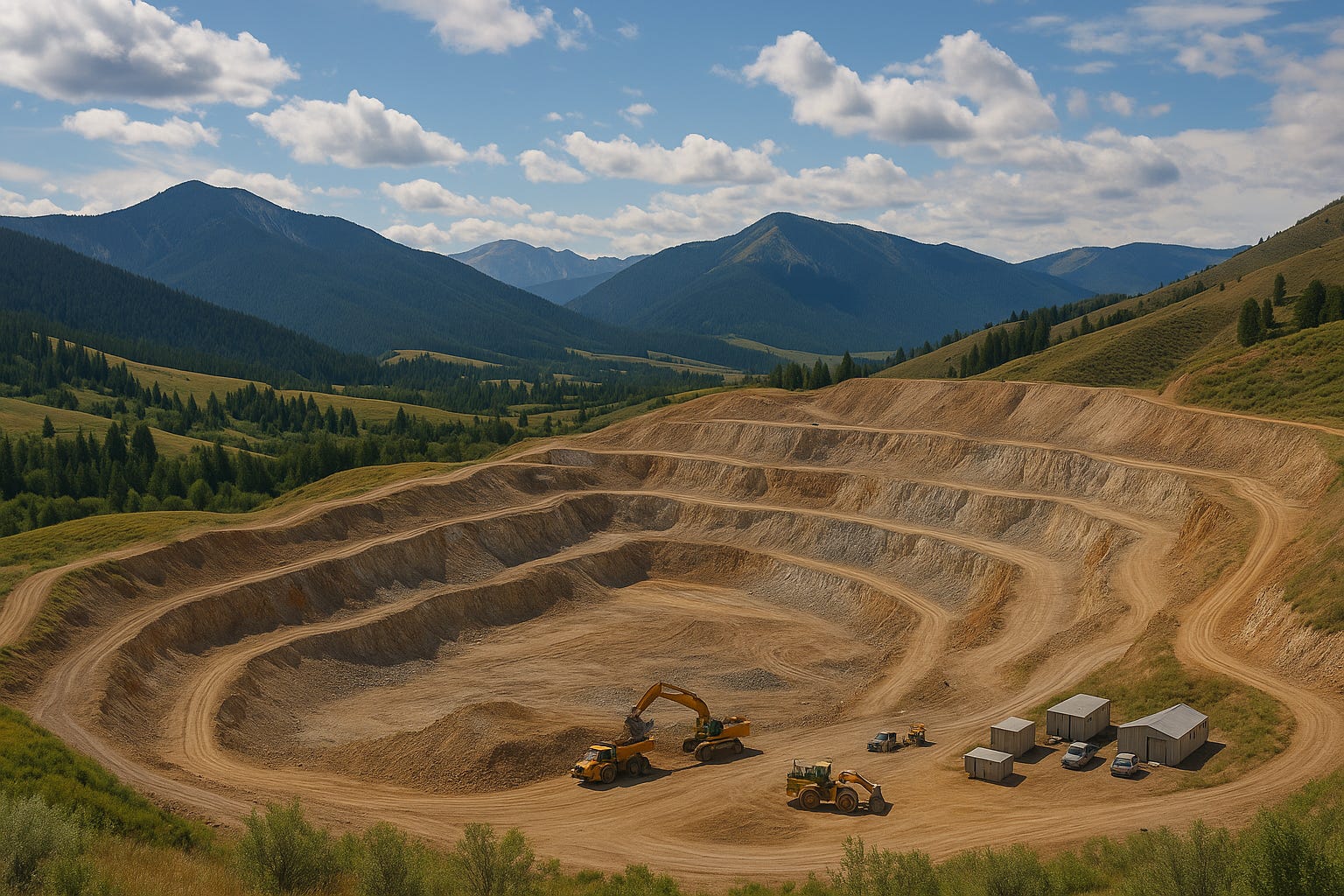
Idaho's next mining rush is no longer a rumor on the edge of public land. State and federal records now show a faster permit clock around antimony, gold, silver, phosphate and other minerals, with rural jobs, national security, property, water and reclamation obligations all riding on how the projects move.
Permits are becoming the pressure point
A recent report on Idaho mining activity found a sharp increase in reclamation-plan approvals between 2023 and 2025, a sign that exploration and production pressure is moving from talk to paperwork. That matters because a reclamation plan is not a ceremonial form. Idaho Department of Lands material says the state administers the Mined Land Reclamation Act, the Dredge and Placer Mining Protection Act and abandoned mine programs, along with mineral leases on endowment trust lands.
The state application form says operators of surface mines, new underground mines or underground mines with large expansions must obtain an approved reclamation plan and financial assurance. In plain English, the company has to tell Idaho how disturbed land will be repaired and prove money is available for that work. That is the taxpayer and property-rights hinge in the story. Faster mining only works if local land, water and rural counties are not left with the cleanup bill later.
Gov. Brad Little's 2025 SPEED Act adds the political frame. The order was pitched as a way to coordinate state permitting for large projects tied to energy independence, national security and economic development. For mining, the test is whether state agencies can move with speed and still keep land accountability visible to the public.
Critical minerals put rural Idaho in the middle
The Governor's Office of Energy and Mineral Resources says Idaho's mineral production has been below several western peers, but has trended upward again since 2019. The same 2026 landscape report says mining, quarrying, and oil and gas extraction contributed $1.28 billion to Idaho's gross domestic product in 2023 and supported 13,801 direct and indirect jobs.
Those numbers explain why this is not just an environmental-process story. Mining decisions hit paychecks, county roads, contractors, machine shops, public schools supported by endowment lands and families in towns that do not have endless ways to replace a lost industrial job.
The national security piece is just as direct. The state report lists Idaho minerals including antimony, cobalt, lead, silver, zinc and phosphate. It says antimony is used in ammunition, semiconductors, optics, batteries and flame retardants, and notes that China banned antimony exports to the United States in December 2024 after America had relied heavily on Chinese supply. That puts Idaho ground in the middle of a supply-chain fight Washington can talk about, but rural Idaho has to live with.
Federal dashboards show where the stakes are landing
The federal permitting dashboard already lists Idaho projects that show how broad the pressure has become. Antimony Ridge in Valley County is described as a bulk-sample mining program for high-grade antimony in the Boise and Payette National Forests. Another federal project page says the work includes roughly 50 drill sites and two bulk-sample trenches, with at least 500 tons of material expected to be removed from trenches.
The same federal project list includes DeLamar, an open-pit gold and silver mining development in Owyhee County. Together, the entries show why Idaho's debate cannot be reduced to a simple yes-or-no fight over mining. The real question is whether the state can defend work, national supply chains and rural opportunity while forcing companies to meet reclamation promises in public view.
That is the Idaho bargain worth watching. Move too slowly and the state leaves jobs and strategic minerals to other places. Move too carelessly and taxpayers, ranchers, watersheds and small counties inherit the damage. The permit clock is running. The accountability clock should run with it.