
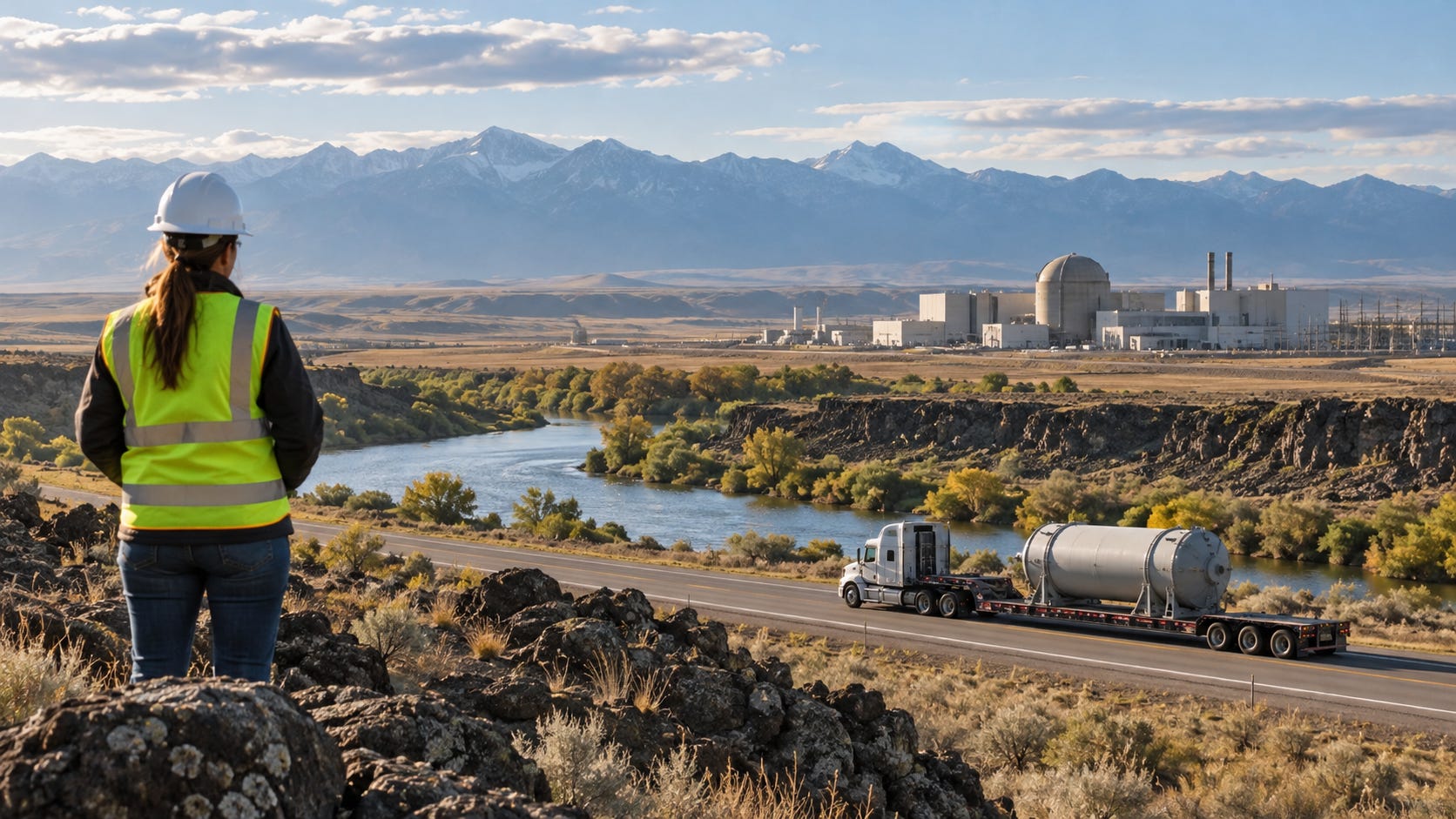
West Virginia pulled out of the race for a federal nuclear campus on Sept. 30, the day its host agreement was due, rather than sign a deal that would have covered spent fuel from other states. Idaho is still at the table, and Gov. Brad Little has put his terms on the record: no spent fuel stored above the Eastern Snake Plain Aquifer, safety guarantees he calls nonnegotiable, and an answer to what he calls the big question for every state in the hunt. "Where is the money?"
The prize is big. By the U.S. Department of Energy's count, a Nuclear Lifecycle Innovation Campus could create about 25,000 jobs, pull in up to $50 billion of capital investment and bring up to $10 billion in tax revenue to state and local governments. The cost of entry is just as concrete. A DOE representative said in September that a host state must take in other states' spent nuclear fuel and radioactive waste, not just its own.
What Idaho would be asked to take
DOE has not said how much material would come. The DOE official put the national stockpile of used fuel that has never been reprocessed at 97,000 metric tons and said each campus's share depends on how many campuses are built and which reprocessing technology they use. If three states are picked and split the stockpile evenly, each could take about 33,000 metric tons. That estimate has come from Rep. Monica Church, a Boise Democrat who opposes the project, and from Joel Case, who managed federal projects for DOE and at Idaho National Laboratory, or INL, before retiring in 2022.
Sen. Dave Lent, an Idaho Falls Republican who supports the campus, offered a way to picture Idaho's possible share: a single football field covered to a height of 30 feet.
The DOE official also drew a line between the campuses and Yucca Mountain, the Nevada repository that was halted after public opposition. A campus, the official said, would need a much smaller mined repository, and reprocessing changes what kind of waste is left at the end.
Little says the memorandum he signed with DOE in July does not obligate Idaho to host a campus or take any waste. In his telling, it is a seat at the negotiating table. The document does spell out that a host state must accept shipments from other states, and it says it is not a commitment of federal money. A response Little signed in March described a schedule of "months rather than decades," with first capabilities running in 2027. Now he says there is a long way to go. DOE may want host sites identified by the end of the year, he said, but nothing signed then would be a final agreement.
Who pays is still an open question. Little and Lloyd Knight, who directs policy in the governor's office, said companies operating at or near a campus would bring private investment and that spent fuel remains DOE's responsibility. Knight suggested a host state could charge for storing spent fuel or waste.
The 1995 deal Little calls leverage
Any deal would run into an agreement a Republican governor signed three decades ago. After Idaho sued the federal government, Gov. Phil Batt signed the 1995 Settlement Agreement, which caps the radioactive material that can be shipped into Idaho and sets deadlines for cleaning up and removing waste already in the state. His Democratic predecessor, Cecil Andrus, had warned he would send the Idaho State Police to stop nuclear waste shipments from entering Idaho.
Little calls the agreement "sacrosanct" and says it gives Idaho leverage. He also says it has already been revised five or six times and would need another change, this time to adjust the cap, for Idaho to host a campus. Its major deadlines arrive in 2035, and Little, Church and other officials say DOE is not on pace to meet them.
Case, who spent much of his career carrying out the agreement, said Idaho should lean on that leverage rather than accept all of the fuel. He said he would not take the federal government at its word, even as someone who used to work for it, and noted that some of the agreement's milestones have already been missed. Supporters and skeptics alike expect new construction. Lent said Idaho would have to build larger facilities, while Case said nobody has spelled out who would cover that cost.
Retired Idaho Supreme Court Chief Justice Jim Jones said a campus could be run safely and benefit Idahoans, but he is uneasy about the pace and sees "more questions than there are answers." He called the 1995 pact unique, the only binding deal of its type that DOE has entered on nuclear waste, and said it gives the state substantial leverage. He wants state officials to start holding public hearings and comment sessions across Idaho right away, laying out the plan and the guarantees that would come with it.
Lawmakers backing the bid point to jobs and revenue
The bid has dozens of backers at the Statehouse. On Aug. 17, 46 of the Legislature's 105 members, including Senate President Pro Tem Kelly Anthon of Rupert and House Speaker Mike Moyle of Star, signed a letter to Little and Lt. Gov. Scott Bedke pledging to put a priority on bills covering funding mechanisms, permitting authority and investment in the workforce to keep pace with DOE's timeline.
Lent, who led training programs at INL before retiring, called it the most secure new revenue source open to Idaho and said it would bring "billions of dollars" into the state. INL researchers already handle much of the lifecycle work, he said, including reprocessing spent fuel into new reactor fuel. He said he opens every discussion with two nonnegotiables: protecting the health of Idahoans and protecting Idaho's environment.
Rep. Erin Bingham, another Idaho Falls Republican, wrote in an op-ed that her children are growing up in a hometown whose identity rests partly on being the birthplace of nuclear energy. She argued that used fuel is not the same as high-level waste bound for permanent burial because it keeps most of its original energy value, and she described the campus as a research and manufacturing mission. INL officials declined to comment.
Why West Virginia walked away
West Virginia lobbied its way onto the finalist list in early September. Its April pitch to DOE laid out a phased start built on recycling spent fuel and storing it on an interim basis. After a newspaper story described the bid as an offer to store nuclear waste, Gov. Patrick Morrisey posted that his state would not become "a dumping ground" for it. On deadline day, his energy office sent a one-page letter saying the state was unable to sign the host agreement and meet all of its terms. Under the memorandum West Virginia had signed, that agreement had to cover accepting spent fuel and high-level radioactive waste from out of state.
Five finalists remain: Idaho, Utah, Tennessee, Oklahoma and Louisiana. DOE is expected to pick three host states before the year is out. Idaho's memorandum listed the same Sept. 30 deadline, but Little said in late September that he did not expect a deal that quickly and that the two sides could keep talking or sign a new memorandum with a later deadline.
For Idaho families who rely on the aquifer for drinking water and the farms that irrigate from it, the question is what DOE is willing to put in writing. Little wants no spent fuel over the aquifer, rock-solid safety guarantees and long-term funding commitments for storage, reprocessing, monitoring and security. Asked whether he would sign a deal that was anything less than rock solid, he said no.
Before the other major problems, what about optics? Idaho is an outdoor destination for tourism and new residents. One of the country’s most beautiful states. World class ski resort. Under this proposal we will be seen as the country’s nuclear waste dump. People don’t like that. In the same way the nation sees Idaho as a white supremacy state. I’m not moving to a state that takes spent nuclear waste and material. Look at the bifurcation between The Frank Church wilderness area and the nations nuclear dump.