
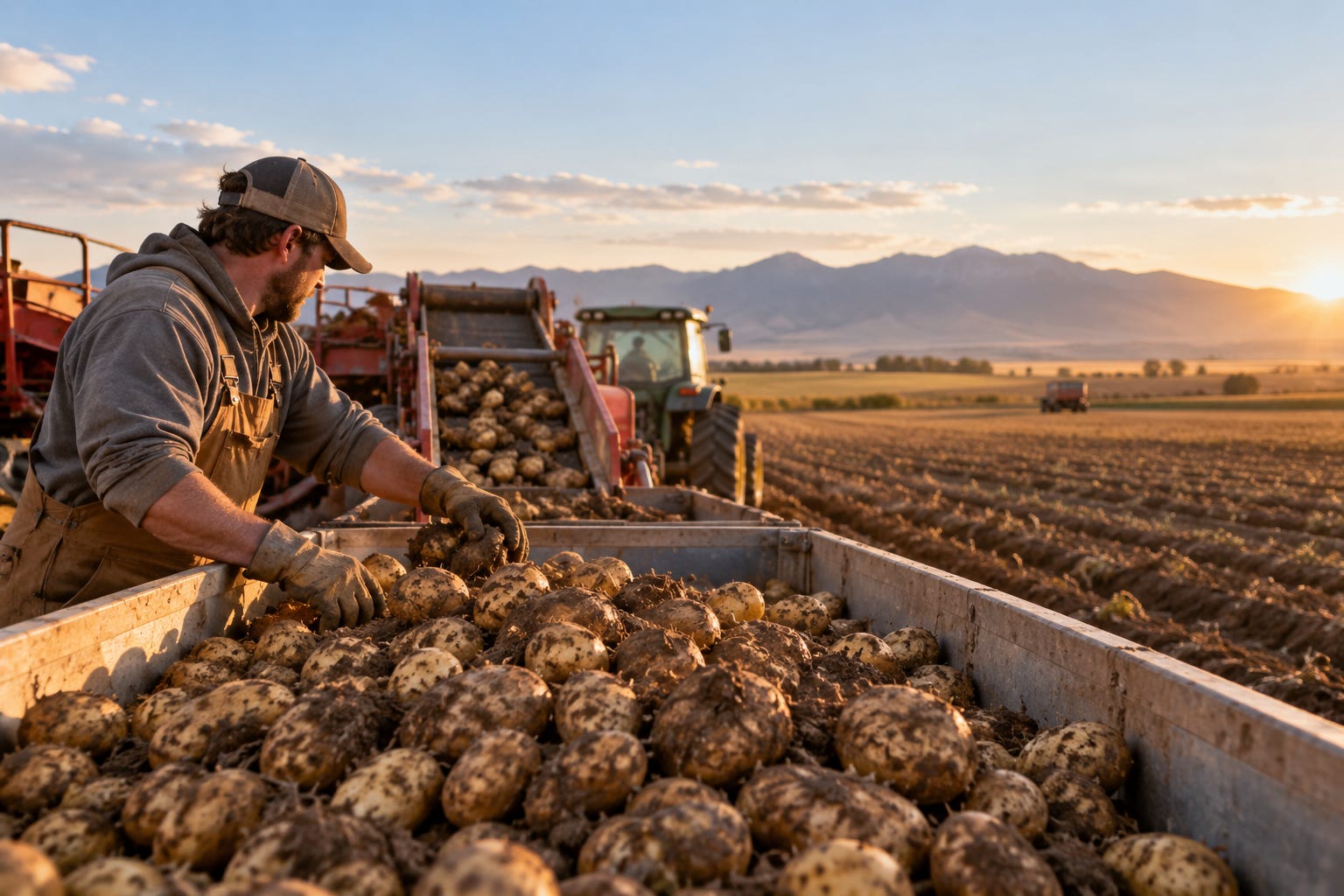
At the Driscoll brothers' farm in Hazelton, potato prices are finally improving after several lean years. But manager Landon Driscoll says this season's Russet Burbanks are yielding about 450 to 460 sacks an acre, rather than the farm's usual 500.
That is the tradeoff emerging across Idaho's potato country as growers bring in the 2026 crop: a better price, but fewer potatoes to sell. Farmers in the Magic Valley, eastern Idaho and the southwest describe a season shaped by limited water, frost, summer heat and, in some fields, wildfire smoke.
The Idaho Potato Commission has not put a final number on the statewide yield decline. Its planting estimate, based on individual field counts, was 298,915 acres this year. Harvest reports now show why acreage alone cannot tell growers what their season will earn.
Better quality does not mean more potatoes
Travis Blacker, a vice president at the Idaho Potato Commission, reported broadly consistent quality in September while cautioning that the size of the yield decline was still uncertain. He pointed to frost, heat and wind as complications absent from the unusually favorable 2025 season.
The effects differ by farm and variety. Near American Falls, Kamren Koompin grows potatoes destined for fried products. His red and Umatilla varieties were producing less than last year's strong crop and slightly less than the long-term average. His Clearwater Russets, by contrast, appeared close to average for both yield and quality.
Koompin described early planting followed by cold spells and later frost. Warmer summer nights also affected varieties that benefit from a larger gap between daytime and nighttime temperatures. He reported lower specific gravity, a measure of potato density, alongside reduced yields.
Near Hammett, Nick Blanksma also reported respectable quality but below-average yields. He cited warm nights and damage from wildfire smoke. By late September, however, conditions for digging were favorable and his harvest remained on schedule.
Those distinctions matter. A disappointing yield is not the same thing as a ruined crop, and reports from individual farms are not a final statewide production count.
Water limits reached the planting decisions
In Oakley, Randy Hardy planted about 600 acres of potatoes on his 2,600-acre farm. He reported reducing planted acreage by roughly 320 acres while managing restricted water supplies, and anticipated a 5 to 10 percent decline in potato yields.
Hardy draws surface water from the Lower Goose Creek Reservoir. He said his groundwater wells ran continuously this year when surface supplies were insufficient, rather than remaining unused as they would with adequate reservoir water.
Aberdeen grower Ritchey Toevs reported planting about 1,200 acres of potatoes. His harvest began Sept. 10, with smaller spuds and yields about 20 percent below last year. He had enough water to finish the growing season, but reduced fall irrigation.
University of Idaho agricultural economist Patrick Hatzenbuehler linked reduced potato planting to water shortages, with some growers switching to less water-intensive crops or leaving potatoes out. Idaho's water resources department issued a statewide drought declaration in April.
A price recovery is not a grocery shortage
Driscoll said the Hazelton operation had spent roughly three years cutting costs wherever it could, including fertilizer, equipment and parts, as potato prices struggled. The recent price improvement helps, he said, but has not fully made up for those difficult years.
His farm nevertheless expected to fill its storage cellars, which each hold about 8 million to 10 million pounds. The local harvest report did not anticipate a noticeable shortage for grocery shoppers or restaurant customers.
Other growers' crops feed different parts of the food business. Hardy's potatoes go to Sun Valley Potatoes in Rupert for eventual distribution to retailers and food-service customers. Toevs supplies Lamb Weston in American Falls for frozen potato products.
Hatzenbuehler reported improving potato prices but noted that higher diesel costs during harvest can absorb some of the benefit. He saw reason for optimism for producers able to harvest good-quality potatoes and store them successfully.
Growers are already looking toward 2027
The immediate work is finishing the harvest. The next planting decisions are already taking shape.
Toevs said limited water remaining for next year could force a different crop plan, potentially leaving wheat, his lowest-value crop, unplanted. Hardy also described a nearly empty local reservoir and uncertainty about the winter's snowpack.
For those farms, a stronger potato price is welcome. How much land they can put to work next spring still depends on the water available to grow another crop.