
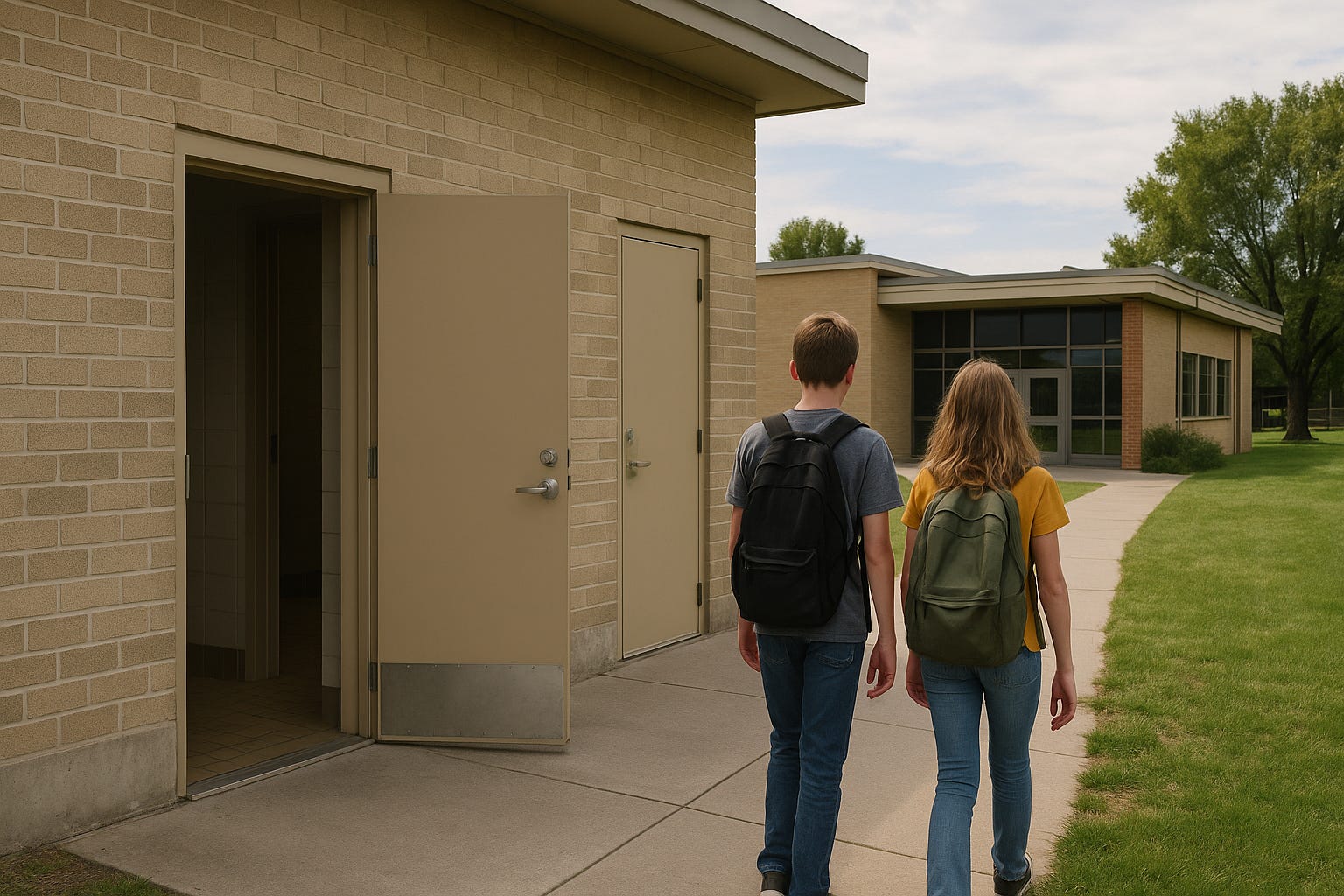
Idaho's 2023 school bathroom law is no longer tied up in the same federal challenge that shadowed public schools for nearly three years. Attorney General Raul Labrador announced May 21 that plaintiffs in Sexuality and Gender Alliance v. Critchfield agreed to dismiss both their U.S. District Court case and Ninth Circuit appeal, leaving Senate Bill 1100 in effect for K-12 public schools statewide.
What the law requires in schools
Senate Bill 1100 was passed by the Legislature in March 2023, signed by Gov. Brad Little on March 22, and took effect July 1, 2023, according to legislative records. The law requires multi-occupancy restrooms, locker rooms, showers and overnight accommodations in Idaho public schools to be designated for male or female students and used according to biological sex. It also requires schools to provide a single-occupancy accommodation for any student who does not want to use a multi-occupancy facility.
That puts the immediate work back on school districts: signage, facility access, staff guidance and private accommodations now have to be treated as active obligations rather than a policy waiting on courts. For families, the practical question is not just what the law says, but whether a school can explain the rule in plain language and handle requests without confusion.
How the court fight ended
The lawsuit challenged the law under the Equal Protection Clause, Title IX and privacy claims. In October 2023, U.S. District Judge David Nye denied a request for preliminary injunction. Labrador's office said the ruling accepted the state's argument that the law was substantially related to an important government interest in student privacy and safety.
The challengers appealed. In March 2025, the Ninth Circuit affirmed the district court, finding that protecting students' bodily privacy is a legitimate government interest and that the law violated neither Equal Protection nor Title IX, according to the attorney general's office. The latest dismissal closes the remaining district court and appellate cases tied to that challenge. Under the stipulation, each side will cover its own costs and fees.
Why this matters beyond Boise
The result gives Idaho districts a clear statewide rule at a time when school administrators already juggle safety, discipline, staffing and parent communication. Local boards and superintendents will still have to make implementation work in real buildings, with real locker rooms, field trips and overnight events.
There is also a taxpayer angle. When public schools are caught between unsettled rules and litigation, district time and legal uncertainty become a cost even when no one writes a new line item into a budget. A closed case lets schools shift from courtroom posture to compliance, training and accountability.
Labrador said Idaho families can be confident the law is fully in effect and will remain so. That is the state's position, and for now it is the operational reality facing Idaho's public schools. Parents who want to know how the rule works on campus should look for district-level guidance on single-occupancy accommodations, who handles requests and how schools plan to apply the policy during athletics, travel and other supervised school activities.