
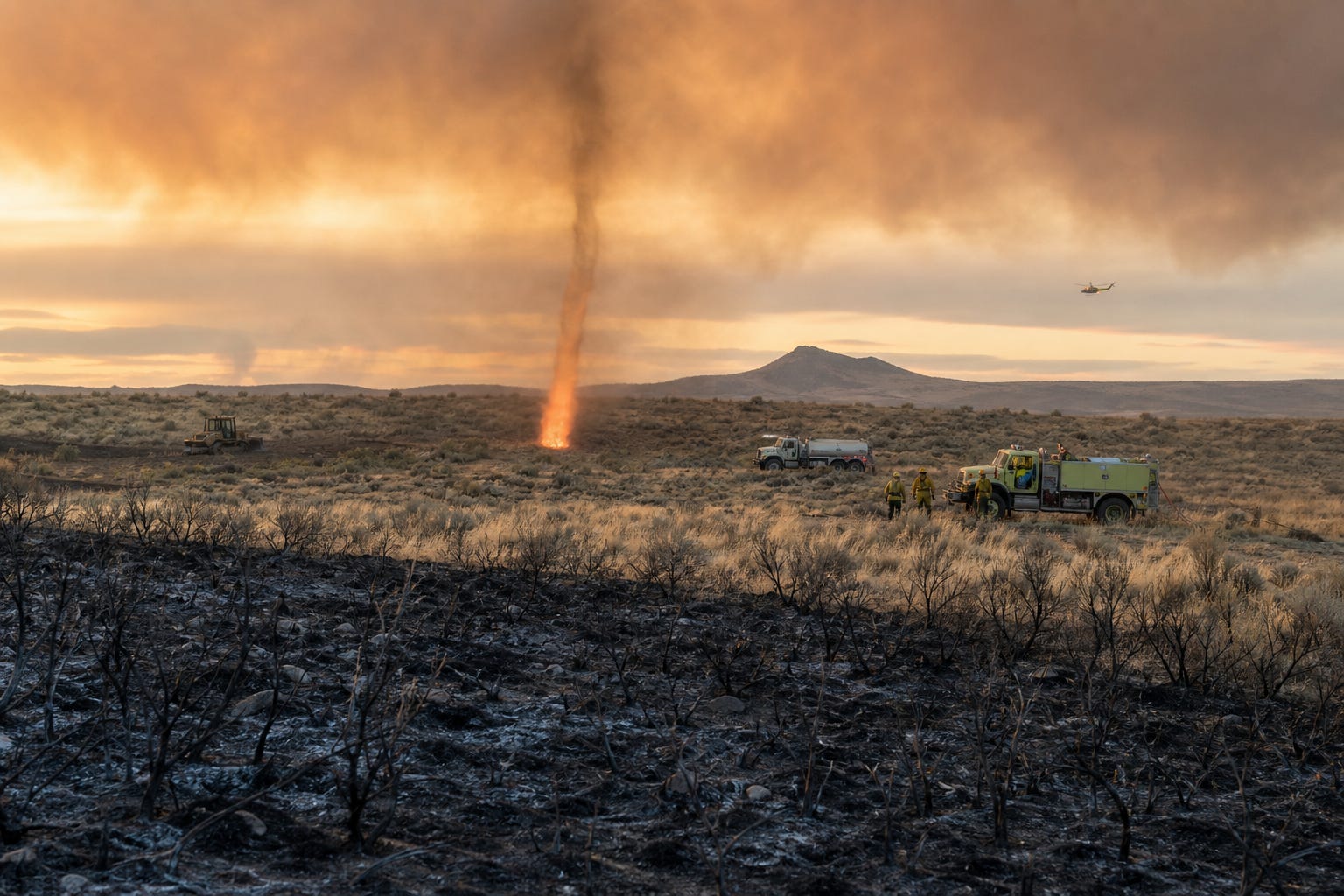
South of Kuna, a fast-moving grass fire grew into a 2,164.6-acre test of local firefighting speed, then produced the kind of rotating flame column that looks unreal on video. Crews contained the Cave Fire by 2 a.m. Thursday, less than a day after it was reported around 3 p.m. Wednesday, Aug. 26.
Video shared by the Kuna Rural Fire District showed a fire whirl rising from the burn. The spectacle drew attention, but the more important fact was on the ground: local departments, federal crews, aircraft and heavy equipment kept a wind-driven rangeland fire from continuing its run toward roads, property and the community.
The response was built for speed
The first incident reports placed the fire about four miles south of Kuna Butte on land managed by the Bureau of Land Management. In its early hours, the blaze moved through dry grass and sage while changing winds pushed the flame front in new directions. Officials reported that it was making active runs, the kind of behavior that can erase a comfortable distance quickly.
The initial attack reflected that risk. The response included four engines, two bulldozers, a helicopter, an air-attack aircraft, several retardant planes, an investigator and overhead command. Kuna Rural Fire, Melba Fire and Upper Deer Flat Fire joined the federal response. Ground crews cut dozer lines while engines and aircraft worked the active edges.
Authorities temporarily shut the Swan Falls Road corridor beginning at West Nicholson Road and extending toward the dam while equipment moved and aircraft worked overhead. Drivers were also told to stay away from West Warren Spur Road and Black Cat Road. Early updates reported no evacuation orders. By Wednesday evening, firefighters had stopped the blaze's forward movement. The road later reopened, and crews stayed to cool hot spots and strengthen the line around the burn.
The final mapped area was 2,164.6 acres. Containment came at 2 a.m. Thursday. Investigators had not announced an ignition cause in the latest incident updates.
The spinning column was not a normal tornado
A fire whirl forms when intense heat sends air and gases sharply upward and the rising column begins to rotate. That rotation can pull flames, ash and debris into a tight vertical spiral. Fire crews often call the phenomenon a fire devil or fire whirl. The popular name "firenado" is vivid, but most of these columns are not produced by a thunderstorm the way an ordinary tornado is.
Many fire whirls stay small. Larger ones can become a serious operational hazard because they concentrate heat, carry burning material and make the fire's next movement harder to read. The Kuna video mattered for more than its drama. It captured the kind of fast-changing behavior firefighters must recognize while they are already working around smoke, uneven ground, heavy machinery and shifting wind.
The Cave Fire did not need to become a true tornado-strength event to be dangerous. Its rapid growth, road closure and rotating flame column all happened during a response that lasted hours, not days. That is the practical lesson: open rangeland can move from ordinary summer scenery to a public-safety problem before most nearby residents have time to process the first smoke column.
Southwest Idaho was already on alert
The fire broke out while Stage 1 restrictions were in effect across much of southwestern Idaho, including Ada County. State and federal land managers imposed those rules Aug. 7 after rating wildfire danger as extreme in parts of the region. The restrictions limit wood and charcoal fires to approved permanent pits at developed sites and restrict smoking in flammable areas.
Those rules do not establish what started the Cave Fire. Its cause remained under investigation. They do show the conditions crews and residents were already facing before the first call came in: dry fuels, heavy public-land use and little room for carelessness.
The overnight containment was a concrete public-safety win. It came from a layered response, local departments that knew the ground, federal resources that arrived with air support, and residents who stayed off closed roads. The flames stopped. The responsibility does not. Until restrictions are lifted and conditions improve, one preventable spark can still put firefighters, ranch country and nearby homes back on the same clock.