
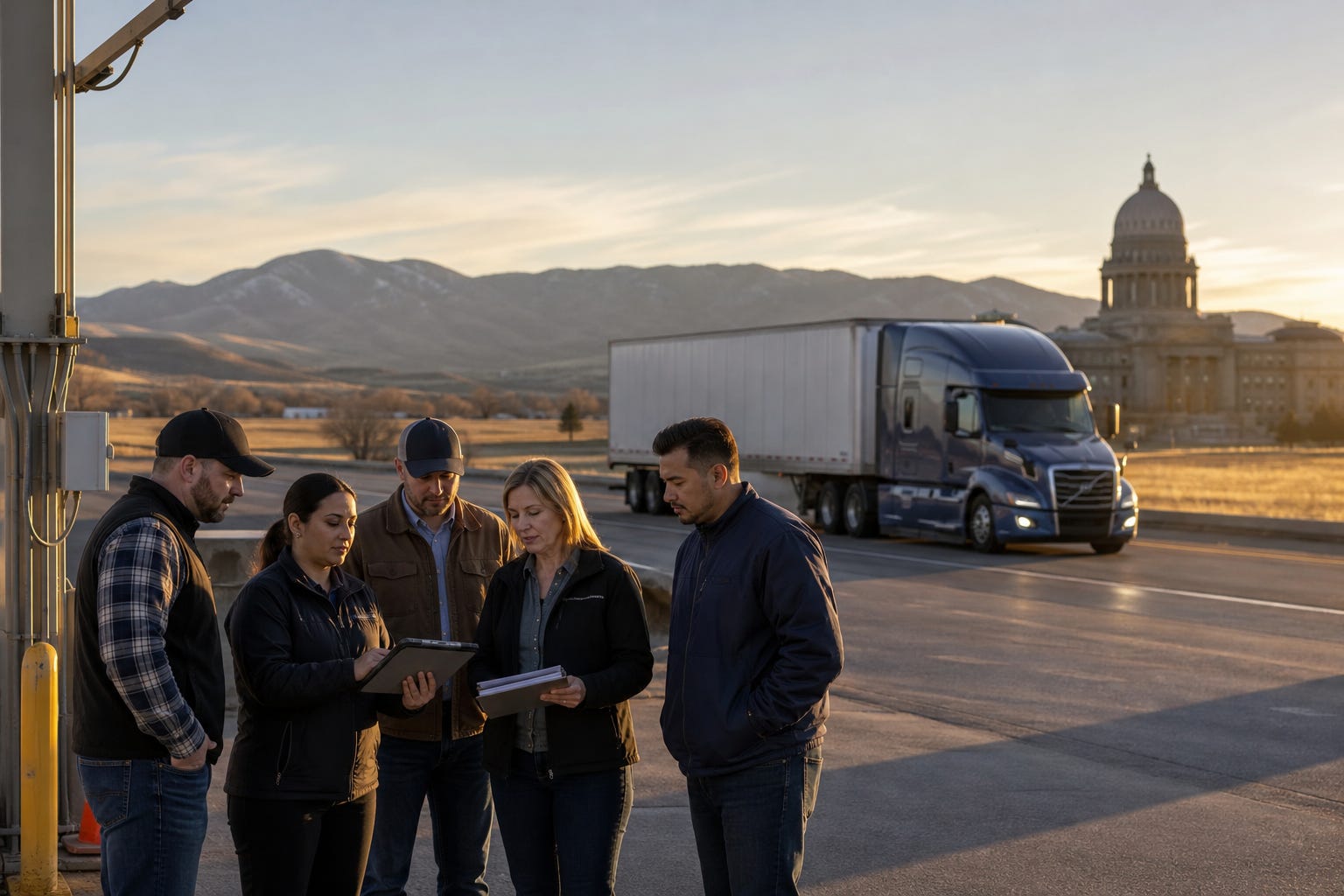
Idaho Attorney General Raúl Labrador put the state into a national truck-licensing fight Friday, joining a Florida-led court brief in defense of a Trump administration rule that sharply narrows who can receive a non-domiciled commercial driver's license.
The rule is already in force. A divided federal appeals court refused to pause it in May, and Labrador's office says oral argument is set for September 15. For Idaho families, trucking companies and drivers, the case is a test of whether every commercial license can rest on a verifiable safety record, even when the applicant's driving history begins outside the United States.
The federal rule creates a tighter license test
The Federal Motor Carrier Safety Administration published its final rule on February 13 and made it effective March 16. For most foreign-domiciled applicants, eligibility is now limited to people holding H-2A temporary agricultural worker status, H-2B temporary nonagricultural worker status or E-2 treaty investor status.
The change goes beyond naming three visa categories. Applicants must present an unexpired foreign passport and an I-94 arrival record. State licensing agencies must check immigration status through the federal SAVE system, keep copies of application documents for at least two years and require the applicant to appear in person for each renewal. A credential cannot last longer than the I-94 or one year, whichever period is shorter.
FMCSA said the old process left a basic gap. States can search domestic commercial license files, the National Driver Register and federal drug and alcohol records. They generally cannot inspect a foreign applicant's driving record from another country. The agency also found widespread mistakes when state clerks had to interpret immigration codes on employment authorization documents.
The new system substitutes a shorter list and more uniform documents for that patchwork. It also requires a state to downgrade a license if the holder is no longer eligible.
Labrador is backing the rule in court
Labrador joined an amicus brief in the D.C. Circuit case challenging the rule. His office presented the move as support for the Trump administration's effort to enforce one commercial licensing standard across state lines, with highway safety and family protection at the center.
That interstate point matters in Idaho. A commercial license issued in another state can put a driver on the same I-84 and I-15 corridors used by Idaho commuters, farm shipments and small businesses. Licensing failures do not stay inside the state that made them.
The appeals court's May 5 order gives Labrador's side an early advantage, but not a final victory. Judges Gregory Katsas and Neomi Rao concluded that the challengers had not shown a strong likelihood of success and denied an emergency stay. Judge Robert Wilkins would have granted it. The court then accelerated the case for a September hearing.
The majority said FMCSA had corrected problems that led a prior panel to halt an earlier version of the rule. Before issuing the final version, the agency consulted states, used a public comment process and reviewed more than 8,000 comments. The court also found that FMCSA had built its case around missing foreign driving records and licensing compliance, not a blanket claim that foreign drivers are more dangerous.
The workforce impact will arrive over years
The numbers are large. FMCSA estimated that roughly 200,000 people held non-domiciled commercial licenses and another 20,000 held learner's permits. It expects about 6,000 non-domiciled licenses a year to qualify under the H-2A, H-2B and E-2 categories. The agency projected that roughly 194,000 current license holders would leave the freight market over about five years as credentials come up for renewal.
That is about 5 percent of the 3.8 million active interstate commercial license holders counted in 2024. FMCSA said the phase-in should give carriers and drivers time to adjust, while challengers argue that workers and employers will bear substantial costs.
The legal category is also more precise than the political shorthand. The court described the affected drivers as foreign-domiciled people who are lawfully present in the country but do not hold one of the three qualifying statuses. They still must satisfy the ordinary driving tests and domestic record checks. The dispute is whether those checks are enough when foreign history cannot be retrieved, and whether FMCSA reasonably drew the new eligibility line.
September puts the safety floor on trial
The rule remains effective while the merits case continues. At oral argument, the challengers can still press claims that FMCSA exceeded its authority or acted unreasonably. The agency will have to defend its visa categories, document rules and treatment of current drivers with a full record rather than an emergency timetable.
For Idaho, Labrador's filing is a clear position on that coming test. Commercial drivers keep farms, stores and manufacturers connected, but the license carries responsibility because an eighteen-wheeler can cross several states in one shift. Idaho is backing a national safety floor built on records that states can verify and rules they can enforce. September will show whether that floor survives the court challenge.