
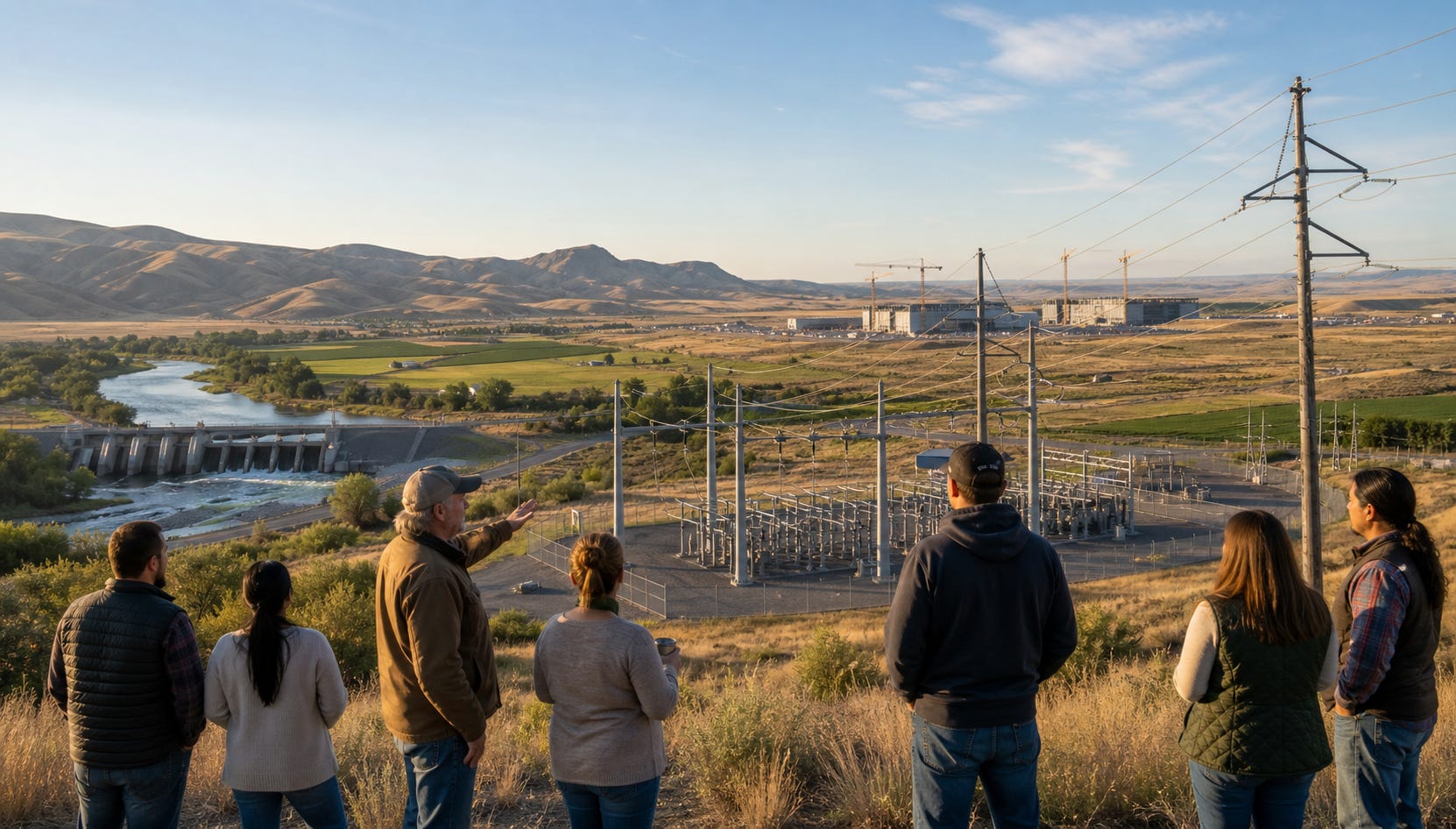
Governor Brad Little joined President Donald Trump at the White House on Thursday to back an expanded pledge built around one hard rule: new data centers should pay for the power plants, transmission lines and grid upgrades they require, rather than shifting those costs onto existing families and small businesses.
The move lands at a consequential moment for Idaho. Idaho Power's latest long-range plan projects that peak demand will climb by about 1,700 megawatts over two decades, with close to 1,000 megawatts of that growth arriving in the first five years. The company says that five-year increase alone is nearly 50 percent greater than the generating capacity of Brownlee Dam, its largest single energy source.
Little's pledge draws a line around the bill
The Ratepayer Protection Pledge began earlier this year with seven major technology companies. The White House expanded it Thursday to include governors, utilities, electric cooperatives, public power providers and data-center developers. Federal officials say more than 200 additional organizations and states joined the commitment, covering about 80 percent of the electricity delivered to American homes and businesses and reaching 263 million people when a new data center is built nearby.
The terms are practical. Large operators commit to build, bring or buy the added generation their facilities need. They cover new delivery infrastructure and negotiate separate rate structures that remain payable even when contracted electricity goes unused. Participants also commit to local hiring and training, along with backup power arrangements that can support the grid during shortages.
Little framed Idaho's participation around three priorities: protecting existing customers, giving local communities a meaningful voice when large projects are proposed, and adding reliable power through an all-of-the-above strategy. He also pointed to advanced nuclear work at Idaho National Laboratory as part of the state's role in meeting national energy demand.
Idaho is still open for investment. The distinction is who writes the check for the extra capacity. Little's position is that a family in Nampa, a farm near Twin Falls or a small shop in Meridian should not finance infrastructure built primarily for a new industrial-scale customer.
Idaho's demand curve makes the stakes real
Idaho Power's 2025 resource plan covers the years 2026 through 2045. It expects the utility's average annual customer count to rise from nearly 648,000 at the end of 2024 to 867,000 by 2045. Meeting that demand will require a broad construction program, not one favored technology.
The plan calls for 1,445 megawatts of solar, 885 megawatts of battery storage, 700 megawatts of wind, 611 megawatts from coal units converted to natural gas, 550 megawatts of new natural-gas generation, 344 megawatts of energy efficiency and 20 megawatts of added demand response. It also identifies major transmission lines connecting Idaho with the Pacific Northwest, Nevada and the wider West.
That buildout is about more than server farms. Population growth, new homes, farms, factories and advanced manufacturing all compete for dependable electricity. Data centers matter because their loads can arrive quickly and at extraordinary scale. A bad contract can leave ordinary customers carrying costs long after a project changes plans. A disciplined contract can bring new generation, construction work and a stronger grid without socializing the risk.
The next proof will be local
The pledge is voluntary, not a new Idaho rate order. Electricity pricing and major utility agreements still move through state-level contracts, tariffs and regulatory decisions. That makes the next stage less ceremonial and more measurable. Idahoans will be able to judge the policy by the terms attached to future large-load projects.
Three questions will matter. Did the developer fund the generation and delivery upgrades tied to its demand? Does it keep paying for the capacity it reserved if the project slows or closes? Did the host community get a real voice on land use, roads and local infrastructure?
Little's White House appearance set a useful standard for Idaho growth: welcome the jobs, the research and the new technology, but keep the bill with the customer that created it. If future contracts hold that line, Idaho can add power and industry without asking working families to subsidize somebody else's expansion.