
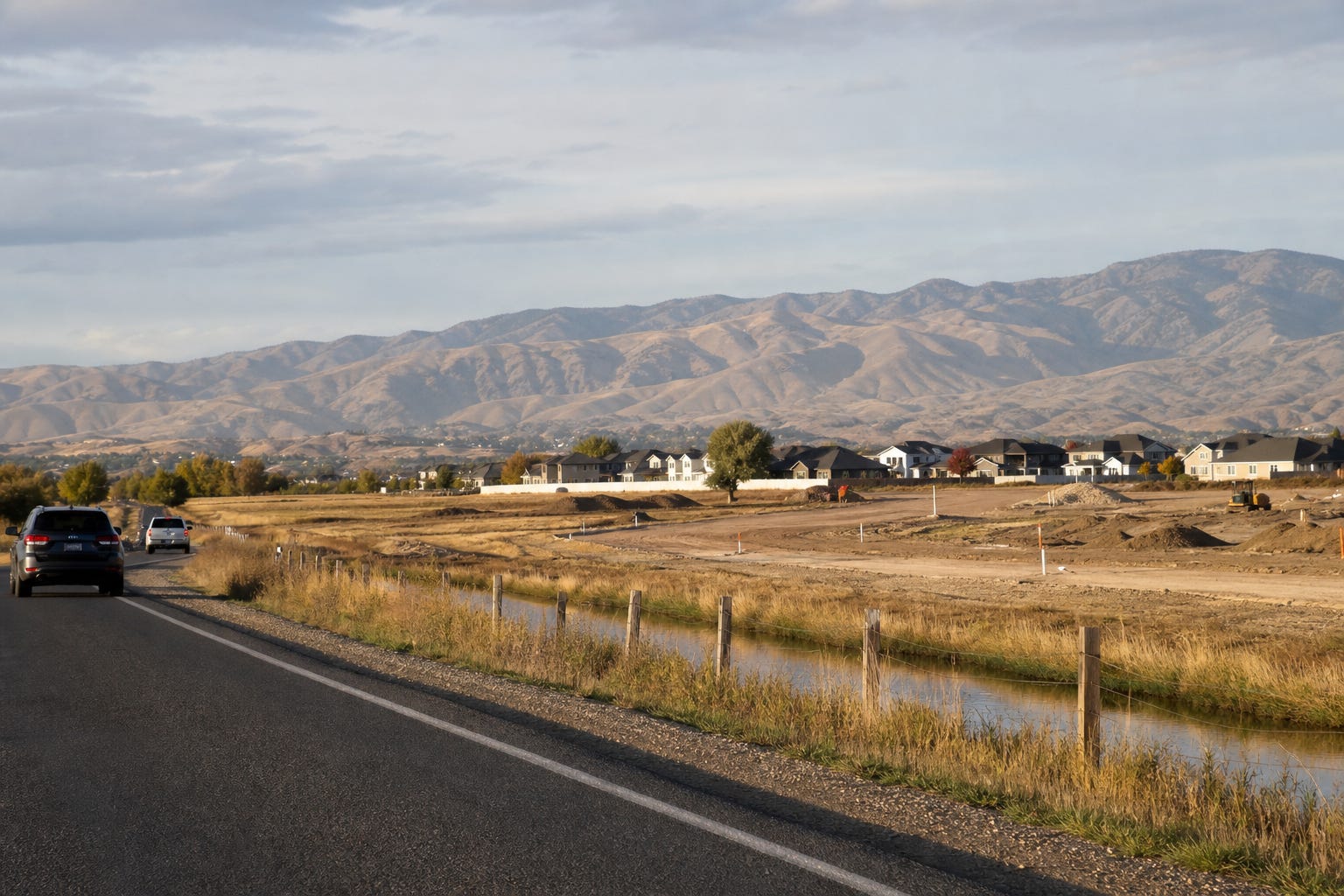
Meridian's next growth fight is no longer abstract. Brighton Development's Basque Ranch proposal would place about 470 residential units on roughly 266 acres north of Spurwing, and nearby residents are already pressing the city over traffic, emergency access and whether the project fits the area's land-use expectations.
A north Meridian project hits the traffic question
The proposal sits in the part of the Treasure Valley where growth looks simple on a map and much harder from a driveway. Neighbors have pointed to Black Cat Road, Jayker Road and Tree Farm Way as pressure points, with church traffic on Chinden Boulevard adding another weekly pinch point. Their concern is not just more cars. It is whether the road network, emergency routes and nearby neighborhoods are ready before hundreds of new homes are approved.
The project is known as Basque Ranch. Public reporting on the application says the Meridian portion includes about 470 homes, with additional development planned across the line in Star. The developer has also described a 55-plus community, a public park and a possible event space. That mix gives the city something more complicated than a simple yes-or-no housing debate. Meridian needs homes, but families also expect roads, fire access, police coverage, parks and other services to arrive with the growth.
Fire access turns a housing plan into a public-safety test
The sharpest issue is emergency access. During the pre-application period, a Meridian Fire Department prevention official reviewed the area and said the proposed access points did not meet fire code criteria at that stage, according to reporting on city correspondence. That does not kill the project. It does move the question from neighborhood preference to public safety.
For residents nearby, the worry is practical. If a child is hurt, a home catches fire or a medical call comes from a new subdivision, first responders need a route that works when minutes matter. Growth politics can get noisy, but that point is not ideological. It is the basic bargain local government makes with homeowners: approve growth only when the public can still count on the services that make neighborhoods livable.
Meridian's own plan makes this the city's call
Meridian's comprehensive plan already frames the stakes. It says unmanaged growth can bring overcrowding, congestion, safety problems, pressure on community identity and a weaker quality of life. It also says development in the city's area of impact should be matched with urban services, including sewer, water, fire, police and parks, while reviews should weigh transportation, schools, libraries and stormwater.
That language matters because Basque Ranch is not only a developer's pitch. It is a test of whether Meridian can keep its growth rules legible to the people who already live there. The same plan says proposals should be judged for traffic, school enrollment and parks, and that the city should coordinate on land use, transportation and emergency services. Those are not decorative planning words. They are the checklist taxpayers will use when the project reaches public review.
The developer says the proposal will comply with city requirements as it moves through the process. City planning officials and, eventually, elected leaders will have to decide whether the final plan proves that. If it does, Basque Ranch could add housing and amenities in a fast-growing corner of Ada County. If it does not, residents will have a strong argument that Meridian is being asked to accept density before the public infrastructure is ready.
The real question is who carries the cost
The local-control issue is simple: growth should pay its way. New homes can bring families, workers and investment. They can also push costs onto existing homeowners if roads, emergency access and city services lag behind the buildout. That is why this proposal has become more than a neighborhood dispute.
Meridian has spent years selling itself as a place to live, work and raise a family. Keeping that promise means saying yes to the right projects at the right scale, with the right services in place. Basque Ranch now has to prove it fits that standard. If the project can answer the traffic, fire access and infrastructure questions, it will have a stronger path forward. If not, the city should make the plan better before asking nearby families and taxpayers to absorb the risk.