
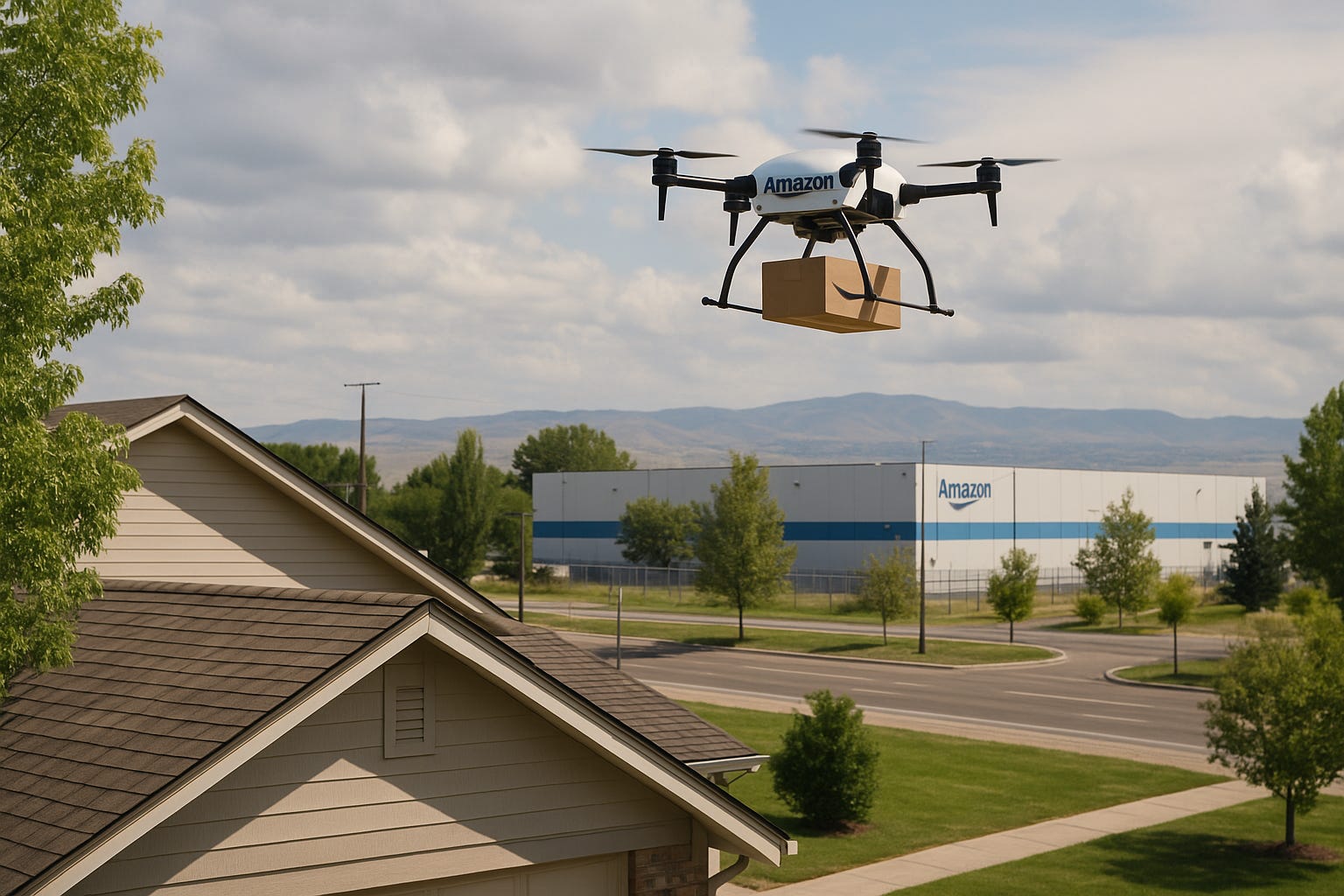
Nampa is now one federal approval away from a new kind of delivery traffic: Amazon drones leaving a Franklin Road hub and flying small packages across parts of the Treasure Valley.
The Nampa Planning and Zoning Commission voted 6-1 on May 26 to approve a conditional use permit for Amazon Prime Air near the company's existing fulfillment site. The local vote does not launch flights by itself, but it moves the project past a major city hurdle while Amazon still needs Federal Aviation Administration authorization before drones start crossing neighborhoods.
The permit puts local airspace on the table
The proposal centers on a drone delivery facility near Amazon's Franklin Road operation. Local reporting says Amazon described a service area of about 7.5 miles from the site, with small packages weighing up to five pounds delivered by drones that weigh about 85 pounds. Another local report said the proposal called for 12 to 15 drones, while Amazon said the project could bring about 30 jobs, including drone operators and maintenance technicians.
That makes the Nampa vote more than a convenience story. It is a local-control test over how fast a national delivery system should be allowed to enter everyday residential airspace, and what conditions should follow it. City review matters because the people under the flight paths are not abstract customers. They are homeowners, parents, workers, school families and small businesses that will live with the noise, safety rules and privacy expectations after the novelty fades.
Amazon says its drones use detect-and-avoid technology to identify people, pets and obstacles. The company has also said the aircraft are not designed for surveillance and that video captured during delivery flights is deleted after deliveries are completed. Those assurances will matter, but so will the public's ability to see whether the system performs as promised once it is operating above Nampa streets.
Residents asked the practical questions
Before the vote, residents raised questions about privacy, noise, internet connectivity and safety. Those are not anti-technology complaints. They are the normal questions a fast-growing city should ask when a private company wants to use the sky above neighborhoods as part of its logistics network.
The drones would operate during daytime hours, beginning 30 minutes before sunrise and ending 30 minutes before sunset, according to local reporting. Amazon has promoted the MK30 drone as quieter than earlier models, able to fly in light rain and built with sense-and-avoid technology. The company also says the MK30 can serve more customers because it can fly farther than previous models.
For Nampa, the tradeoff is straightforward. Faster package delivery and new technical jobs are real benefits. So are the concerns that come with an 85-pound autonomous aircraft moving through a fast-growing city where families already deal with traffic, construction and crowded public systems. The commission's approval means those questions now move from hearing rooms toward real-world rules.
The next decision is federal, but the local test stays here
The remaining gate is FAA authorization. That keeps the launch from being purely a city decision, but it does not make the local stakes disappear. Federal regulators can decide whether the aircraft may fly. Nampa still has to live with where they fly, how often they fly and how well residents believe the rules are being enforced.
That is why this vote should be watched beyond Nampa. Treasure Valley growth keeps bringing national-scale projects into local neighborhoods, from warehouses and roads to power, water and housing. Drone delivery is the same debate in a new form: jobs and innovation on one side, property expectations and public safety on the other.
If Amazon proves the system is quiet, safe and useful, Nampa could become an early Idaho example of private-sector technology fitting into a working city without swallowing local control. If residents feel brushed aside, the first local drone hub could become a warning about approving a future before the ground rules feel settled.
For now, Nampa has opened the door. The question is whether the skies over its neighborhoods are ready for what comes next.