
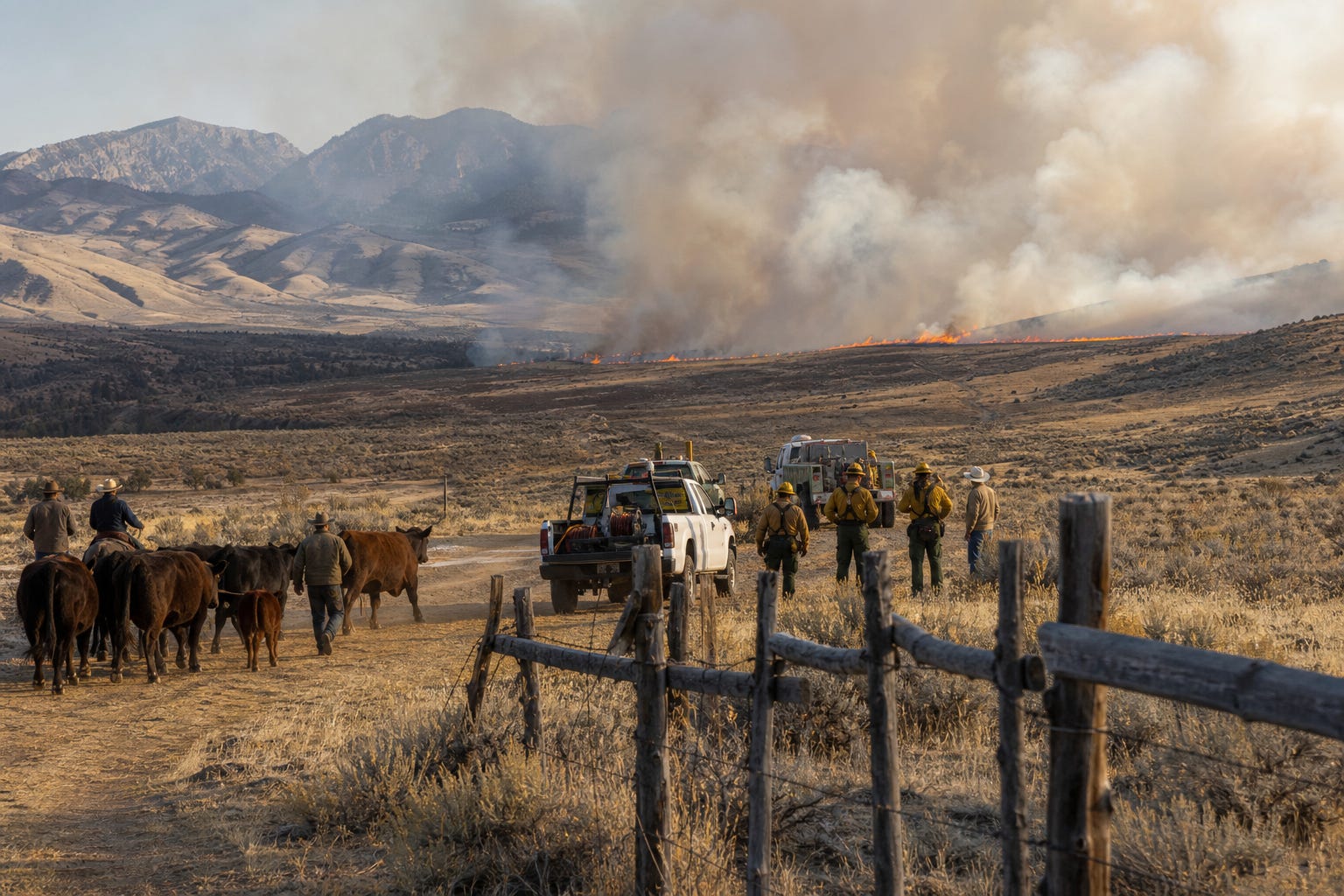
The Big Grass Fire crossed from eastern Oregon into Idaho with a federal interagency incident feed listing 300,000 acres burned, 5 percent containment and 135 personnel assigned late Monday. In Owyhee County, officials say four primary homes have burned and more than 100 cattle have died.
County commissioners responded Monday with a $30,000 emergency allocation and a request for more state assistance. The official incident feed already carried an estimated $1.5 million cost to date. For ranch families around Pleasant Valley, South Mountain and the country southwest of Silver City, the urgent question is how quickly crews, aircraft and relief can reach working land that is already taking losses.
A 300,000-acre fire crossed the state line
The Big Grass Fire was first reported July 23 about 25 miles southwest of Jordan Valley, Oregon. Federal data described it as a multijurisdictional wildfire with extreme behavior, including running and flanking fire. Its cause remained undetermined. The response was operating under a Type 3 incident command with full suppression listed as the strategy.
Acreage estimates shifted as crews refined the perimeter. The Owyhee County Sheriff's Office reported 196,000 acres Monday evening after an earlier preliminary estimate of 280,000 acres. The federal interagency feed later listed 300,000 acres. Officials have cautioned that estimates can change as mapping improves, but every available figure places this among the region's largest active fires.
As of Monday evening, Level 3 GO evacuation orders remained in place for Pleasant Valley, South Mountain and Jordan Valley. Flint Creek Road and the corridor from Pleasant Valley toward Triangle were under Level 1 READY status. The Bureau of Land Management also closed North Fork Campground along Juniper Mountain Road through 11:59 p.m. July 30 to protect the public and firefighters working the Big Grass and Peer fires.
Four homes and ranch livelihoods have been lost
Owyhee County Sheriff Larry Kendrick said more than 100 cattle had died. County officials said four primary residences had burned, while some people in the fire's path were without power. Local ranchers have been working alongside volunteer firefighters to protect homes, livestock and neighboring operations.
Those losses hit working ranches at several points at once. Livestock, forage, fences, power and road access are parts of the same rural economy. When fire takes cattle and closes routes, the damage reaches beyond a perimeter line and into the ability of families to keep an operation running.
Public safety remains the first measure. Kendrick said his greatest concern was preventing loss of life, while ranchers and local officials called for more aerial support and firefighting resources. The fire has also pushed smoke into Southwest Idaho. Regional weather experts identified it as the largest fire affecting Boise's smoky air and warned that the haze could linger if the fire keeps burning.
County money opens a larger resource question
At an emergency meeting Monday, the Owyhee County Board of Commissioners approved $30,000 for firefighting and sought additional state help to protect Silver City and other threatened communities. The federal incident feed estimated $1.5 million in costs so far and carried a $5 million estimated final cost, making the county allocation an immediate local step rather than the full public bill.
Canyon County Sheriff Kieran Donahue said he contacted the Governor's Office, federal officials and the Bureau of Land Management while pressing for added resources. Kendrick also reached beyond his county as the fire accelerated. Their actions show how local control works during a cross-border emergency: county officials identify threatened families, roads and ranches first, while larger state and federal systems supply much of the staffing, aircraft and reimbursement needed to sustain the fight.
The next accountability questions are concrete. Residents need to know how many crews arrive, where aircraft are assigned, whether evacuation routes stay open, when power returns and how emergency money is spent. Owyhee County's ranch families are already paying in livestock, property and lost working ground. The public response now has to protect lives, hold the fire away from remaining homes and ranches, and give local taxpayers a clear account of what help arrived.