
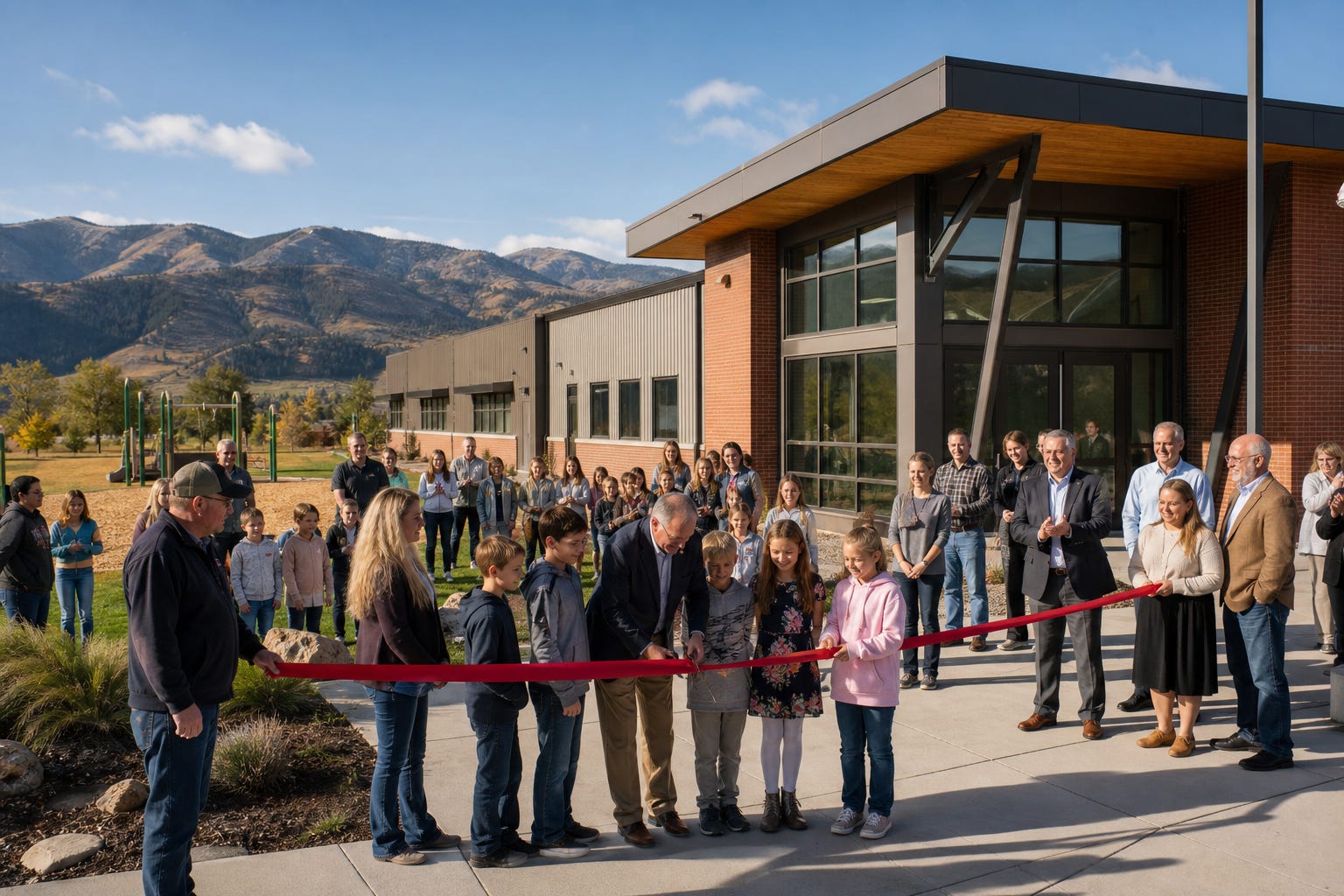
Salmon spent roughly two decades trying to replace Pioneer Elementary, a 70-year-old school whose aging systems had become a recurring concern. The stalemate ended this week with a ribbon cutting for Two Rivers K-8, a roughly $28 million campus built through a rare combination of local debt, state facilities money, private gifts and volunteer labor.
Gov. Brad Little joined Salmon School District Superintendent Jill Patton, trustees, students, contractors and donors on Aug. 5 for the ceremony. The school is scheduled to welcome students Sept. 8. It has 30 classrooms, a gym and a playground, with capacity for 425 students in a district that serves about 600.
At the center of the deal was a $20 million local bond approved in May 2024. Voters had rejected about a dozen earlier efforts. The remaining gap was covered with state support under school facilities laws, fundraising, donated materials and work supplied by the community. For families and taxpayers, Two Rivers is not only a new building. It is a practical test of whether Idaho can repair rural schools without cutting local voters out of the decision.
Twenty years ended with a local yes
Pioneer carried serious maintenance liabilities. Public accounts documented plumbing failures, uneven floors, a deteriorating foundation and sewage backups near the kitchen. Those conditions turned a building question into a student safety and basic-governance question.
The district could not simply order a replacement. Idaho's Constitution generally requires two-thirds voter approval before a school district takes on long-term bond debt. Salmon's May 2024 measure secured 72% support, converting broad local consent into $20 million of construction financing.
That vote provided more than cash. It showed that a large majority was willing to accept a property-tax obligation after years of debate. The Salmon Schools Needs Assessment Committee had spent years assembling a plan, explaining the costs and finding ways to make the local dollars reach further.
Little made the safety of aging school buildings a statewide priority in 2024. At the opening, he credited Salmon residents for doing the local work needed to turn that state policy into an actual school.
State money met volunteer muscle
With the local bond covering $20 million, planners still had to close a gap of roughly $8 million. House Bill 521, approved in 2024, established the School Modernization Facilities Fund and committed state resources to school buildings. The governor's office says Two Rivers is the first school built under that modernization program, together with other state funding.
A second law, House Bill 338, expanded Idaho's school facilities cooperative fund and made smaller requests more workable for rural districts. Earlier project records put Salmon's initial modernization distribution at $2.8 million, far short of the full construction bill. State gap financing, donations and local fundraising had to carry the rest.
Businesses supplied more than checks. R&M Steel donated the building's steel structure. Little presented a Distinguished Service Award to company leaders Rob and Nancy Roberts during the opening ceremony.
Residents also supplied equipment and labor. During 15 organized haul days, volunteers used borrowed dump trucks to excavate the site and replace the material with donated pit rock. Local businesses provided meals for the crews. The arrangement spread responsibility across taxpayers, lawmakers, employers and neighbors, with each contribution tied to a public vote, a law, a named gift or work performed on the site.
Thirty classrooms change the district's daily math
Two Rivers is designed for students from kindergarten through eighth grade. Its 425-student capacity will serve a large share of the district's roughly 600 pupils, while 30 classrooms give teachers and families a modern replacement for a building that had accumulated decades of repair problems.
The gym and playground add space for school programs, and local school leaders expect the campus to host community events as well as classes. That matters in a rural town where a school building often does double duty as civic infrastructure.
The taxpayer test now shifts from financing construction to maintaining what Salmon built. Enrollment, upkeep and public use will determine whether the project delivers value for decades rather than merely solving the next school year. The opening creates a clear accountability line: residents can compare the promises made during the bond campaign with the building their children use.
Idaho now has a rural test case
Little and the Legislature described the 2024 facilities package as Idaho's largest investment in school buildings, paired with property-tax and income-tax relief. Two Rivers gives that policy a concrete result. State support did not replace local control in Salmon. It helped a locally approved plan clear a financial gap that a small district could not cover alone.
The project does not erase the difficulty facing other rural districts. The two-thirds bond threshold remains, construction costs remain high and attendance-based distributions can leave small systems with less money than a replacement school requires. Salmon offers a path, not a blank check: prove local support, disclose the costs, use state programs for the gap and invite businesses and residents to put real resources behind the plan.
The result is measurable. Local voters authorized $20 million. State leaders created financing tools. Businesses and volunteers supplied materials, machinery and labor. On Sept. 8, children are scheduled to enter 30 new classrooms. After 20 years, Idaho's rural school-facilities debate has a building people can walk into.