
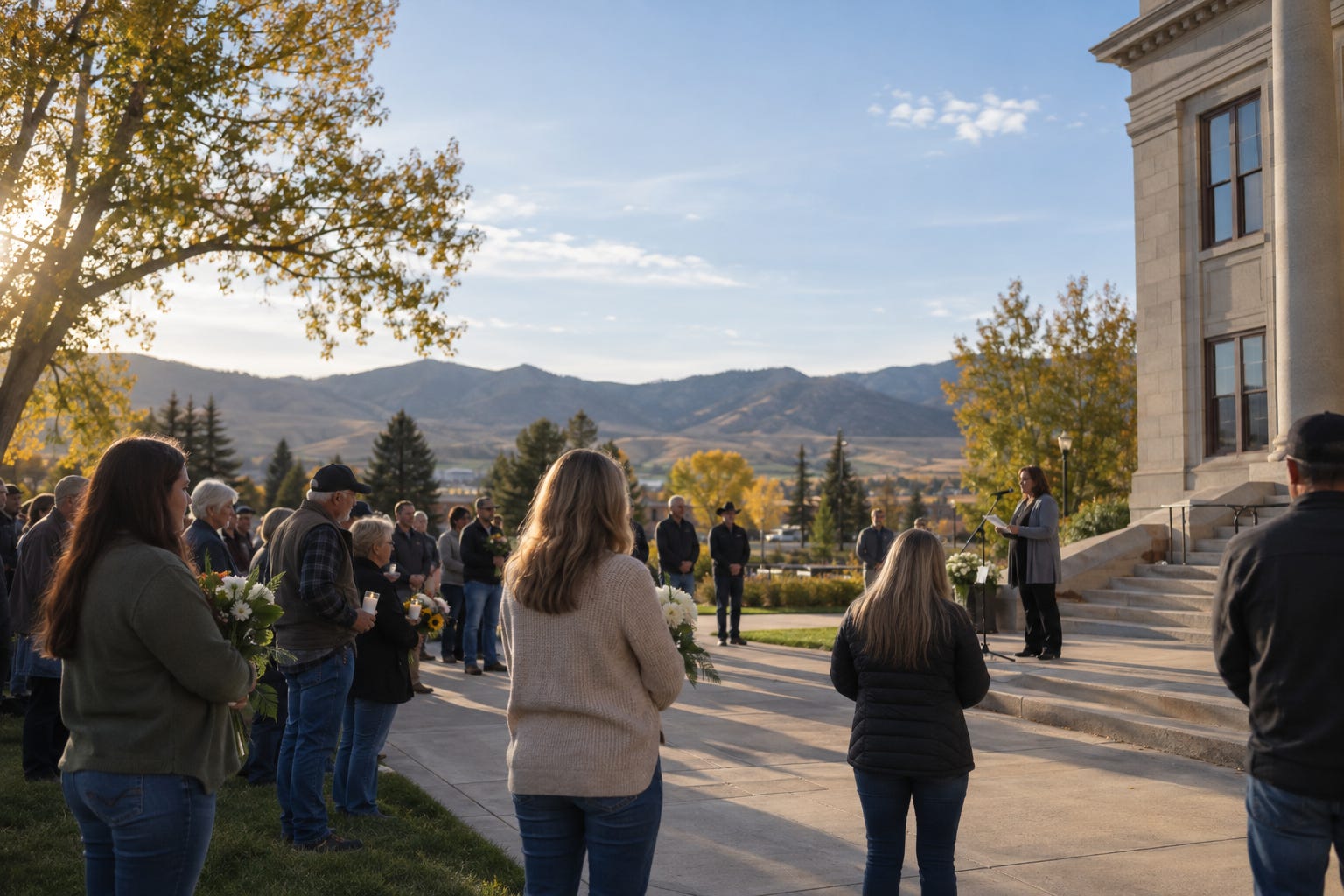
Twenty-five years after 20-year-old Amber Hoopes disappeared from her grandparents' property near Idaho Falls, her case remains active and her family still does not know where she is. On Saturday, a survivor from another eastern Idaho kidnapping stood at the Bonneville County Courthouse and told her story publicly for the first time.
The pairing gave this year's Missing Persons Day a blunt contrast. Megan Lentz escaped and made it home in 2002. Hoopes, who vanished on Sept. 14, 2001, is still missing. Their families have lived with different endings to crimes that shook the same community less than a year apart.
Twenty-five years without an answer
Hoopes was staying with her grandparents when she disappeared in the middle of the night. The Bonneville County Sheriff's Office says the investigation remains active. Saturday's gathering came two days before the 25th anniversary of her disappearance.
Her aunt, Audra Burgener, told those gathered that the timing worked against the family from the beginning. Hoopes disappeared three days after the Sept. 11 terrorist attacks, when national attention was fixed elsewhere. Burgener later helped establish an annual local day devoted to people who remain missing.
This year's observance brought Hoopes' parents, other families and law enforcement together outside the courthouse. Thunder Ridge High School's advanced choir performed, relatives described the young woman they knew before she vanished, and photographs of missing Idahoans put faces beside cases that can otherwise become numbers.
The formal recognition also carried a current purpose. Bonneville County commissioners and Idaho Falls Mayor Burtenshaw had signed a joint proclamation for the Sept. 12 event, describing Hoopes' disappearance as the case around which the local tradition developed. The sheriff's office said the day is meant to show victims' families that they have not been forgotten.
A survivor explains how she got home
Lentz was 14 when she and her two younger sisters slept outside on a trampoline on June 5, 2002. She said she awoke to a man standing over her, threatening her with a gun and forcing her to leave. She was taken to a house, restrained and assaulted.
What followed was a series of details she managed to notice under pressure. Lentz said she saw mail bearing the name Keith Hescock and memorized both the name and address. After hours of struggling, she broke her restraints, used a fire extinguisher to break a chain, forced open a hollow door and reached a telephone. She called her father's secretary, who worked nearby, and escaped from the house.
Lentz told the courthouse crowd that she had asked Hescock whether he knew what happened to Hoopes. He denied knowing. Authorities later treated Hescock as a primary suspect in the Hoopes investigation. He died by suicide during a police standoff after Lentz escaped, and Hoopes was never found.
For more than two decades, Lentz kept the details largely private. She said she chose to speak now because her survival could draw fresh attention to families who never received the homecoming hers did. Her account did not solve the older case, but it made the cost of an unresolved disappearance impossible to treat as an abstraction.
Idaho still has 183 active cases
Bonneville County Sheriff Sam Hulse told the gathering that 183 people are currently listed as missing across Idaho. He named other eastern Idaho cases, including David Butler, whose vehicle was found in the Snake River with his wife inside, and Darwin Vest, who disappeared from downtown Idaho Falls in 1999.
Hulse also connected missing-person work to practical law-enforcement capacity. He asked the public to remember unresolved cases when agencies seek updated crime-lab technology, because old evidence can become useful when better tools become available. For families, a laboratory upgrade is not an abstract budget item. It can be another chance to identify evidence, connect records or eliminate a dead end.
The national count is larger still. The National Crime Information Center has reported more than 83,000 active missing-person records. Each case differs, but the local message on Saturday was consistent: time does not erase the need for reliable records, public attention and investigators willing to revisit what is known.
The next useful fact still matters
A remembrance ceremony cannot produce the answer Hoopes' family has waited 25 years to receive. It can keep a case visible long enough for a witness to reconsider an old detail, for a record to be compared again or for improved technology to find what an earlier examination missed.
That is why Lentz's decision to speak carried weight beyond her own survival. She gave the community a firsthand account of what one remembered name, one address and one successful phone call could do. For Idaho's missing families, the hope is that someone else still holds a fact just as useful.